
In the evolving narrative of New Jersey’s architectural and cultural identity, few projects capture the tension between history and progress as powerfully as the long-awaited revival of Jersey City’s North Baptist Church. After decades of abandonment, structural decay, and uncertainty, the Historic Preservation Commission has granted approval for a bold and carefully considered plan to restore and reinterpret one of downtown Jersey City’s most fragile historic landmarks. What emerges from this decision is not simply a redevelopment project—it is a statement about how New Jersey values its past while building its future.
Located in the Harsimus Cove neighborhood, the North Baptist Church has stood as a silent relic since a devastating fire in the 1970s left it largely hollowed out and vulnerable to time. For years, the building’s skeletal remains—most notably its Jersey Avenue façade—served as both a haunting reminder of what was lost and a question mark about what could be saved. With structural deterioration accelerating in recent years, the urgency surrounding its fate became impossible to ignore. The approval of a comprehensive restoration and redevelopment plan now marks a pivotal turning point, not just for the site itself, but for preservation philosophy across the region.
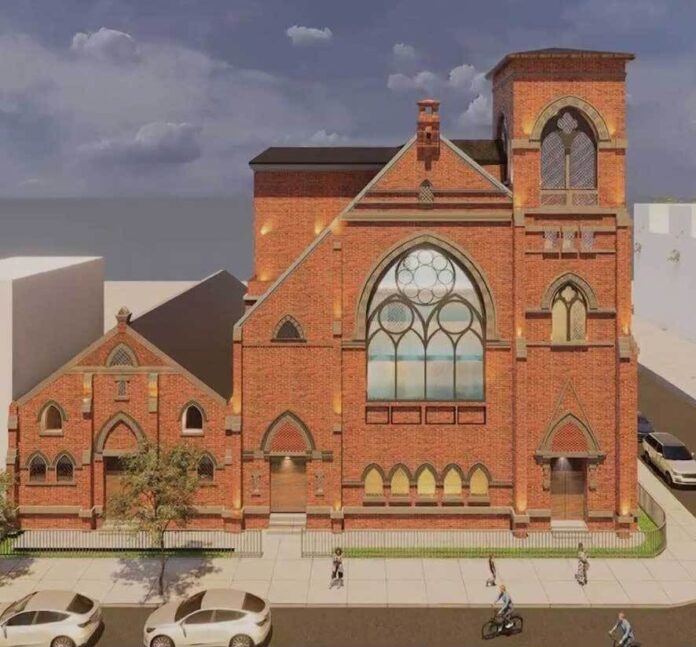
At the center of this transformation is architect Manny Pereiras of Pereiras Architects Ubiquitous, whose vision for the church has evolved through years of planning, revision, and debate. His approach rejects the simplistic notion of replication and instead embraces a layered architectural strategy—one that restores what remains authentically intact while introducing contemporary design where the original structure has been lost. This duality defines the project. Along Jersey Avenue, the surviving historic façade will be meticulously restored, grounding the building in its original identity. Along Fourth Street, where much of the structure no longer exists, a modern interpretation will rise, intentionally distinct yet thoughtfully integrated.
This approach reflects a broader shift in preservation thinking, one that aligns with established federal guidelines while also acknowledging the realities of urban redevelopment. The goal is not to create an illusion of untouched history, but to reveal the passage of time through architecture itself. In doing so, the project positions the North Baptist Church as both a preserved landmark and a contemporary living space, bridging centuries of design philosophy in a single structure.
The debate surrounding this methodology is far from new. Preservationists, architects, and cultural historians have long wrestled with the question of whether restoration should aim for exact replication or embrace modern reinterpretation. The North Baptist Church project brings that debate into sharp focus. While some advocates argue for a return to original aesthetics, others see value in transparency—allowing new additions to clearly reflect the era in which they are built. Pereiras’ design ultimately aligns with the latter, emphasizing honesty in construction and clarity in architectural narrative.
What distinguishes this project within New Jersey’s broader arts and cultural landscape is its commitment to both preservation and reinvention. The plan includes the recreation of defining elements such as the church’s iconic rose window, which was destroyed decades ago, alongside the careful reuse of original materials like bluestone and the restoration of the wrought-iron gate. These decisions are not merely aesthetic—they are symbolic, reinforcing the building’s historical significance while ensuring its continued relevance.
At the same time, the redevelopment introduces a new functional identity for the structure. Like many historic church conversions across New Jersey, the North Baptist Church will be adapted into residential use, a model that has increasingly proven to be both economically viable and architecturally compelling. These conversions often result in uniquely designed living spaces that preserve the grandeur of original structures while meeting contemporary needs. In this case, the integration of the church’s bell tower into a residential unit underscores the project’s ambition, transforming a once-public landmark into an intimate, lived-in environment without erasing its past.
The challenges facing this project cannot be overstated. The building’s condition has deteriorated rapidly, with significant structural instability raising legitimate concerns about collapse. Preservation officials have acknowledged the delicate balance required to move forward, emphasizing the importance of pragmatic decision-making in the face of urgency. The sentiment expressed during commission discussions—that perfection must not impede progress—captures the stakes involved. Inaction, at this stage, would almost certainly result in irreversible loss.
Yet within those challenges lies opportunity. The revival of the North Baptist Church is emblematic of a larger movement across Jersey City and the state as a whole—a renewed commitment to preserving historic spaces while adapting them for modern use. This movement is reshaping urban landscapes, turning once-forgotten buildings into cultural and residential anchors that contribute to the vibrancy of their communities.
Jersey City, in particular, has emerged as a focal point for this transformation. Its proximity to New York City, combined with a rapidly growing population and a strong appetite for distinctive architecture, has created an environment where preservation projects are not only feasible but highly desirable. The North Baptist Church stands as one of the most ambitious examples of this trend, both because of its condition and because of the philosophical questions it raises.
There is also a broader cultural dimension to consider. Historic structures like the North Baptist Church are more than physical spaces—they are repositories of collective memory. They tell stories about the communities that built them, the eras they represent, and the values they once embodied. Preserving these structures, even in altered form, allows those stories to continue shaping the identity of a place. In a state as historically rich and culturally diverse as New Jersey, that continuity carries significant weight.
As construction planning advances, the project will undoubtedly continue to draw attention from across the architectural and preservation communities. It represents a case study in how to approach complex, deteriorated landmarks with both respect and creativity. More importantly, it signals that New Jersey is not content to let its history fade into obscurity. Instead, it is choosing to engage with that history—challenging it, reinterpreting it, and ultimately ensuring that it remains a living part of the state’s cultural fabric.
The North Baptist Church is no longer just an abandoned structure waiting for its fate to be decided. It is now a symbol of possibility, a testament to what can be achieved when vision, expertise, and cultural commitment align. In the heart of Jersey City, a building that once stood on the brink of disappearance is being reimagined as a cornerstone of the future—one that honors its past while embracing the architectural language of today.