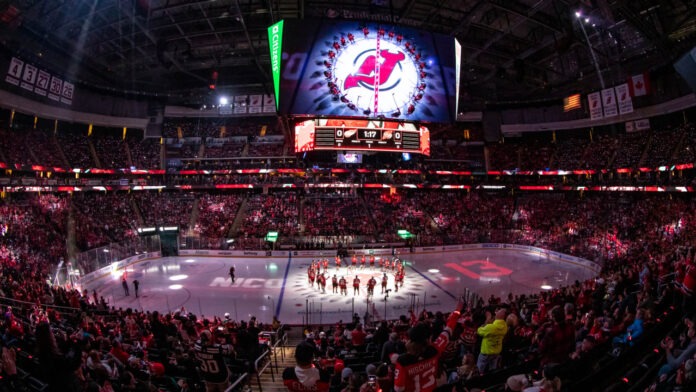

The New Jersey Devils returned to Prudential Center on Thursday night hoping a tighter structure, a simplified game plan, and a renewed sense of urgency could finally halt a slide that has begun to reshape the tone of the season. Instead, the result felt hauntingly familiar. A disciplined, low-event defensive effort kept the New York Islanders almost completely in check, but the Devils once again could not solve their offensive identity, falling 3–1 in a game that became less about a single loss and more about an increasingly troubling pattern.
This was a night where effort was not the issue. Structure was not the issue. Even goaltending, for the most part, was not the issue. What continues to separate the Devils from relevance in tightly contested games is an attack that struggles to create sustained pressure, struggles to convert high-danger opportunities, and struggles to manufacture offense when the opponent refuses to give them space.
The mood inside the building reflected it. There was anticipation at puck drop, but also a quiet recognition that this group has reached a point in the season where every shift feels like a referendum on what the roster truly is and what it still needs to become.
Compounding the frustration surrounding the loss was organizational news delivered earlier in the day, when the Devils placed forward Juho Lammikko on waivers with the intent to terminate his NHL contract. The move, procedural on the surface, quietly underscored the broader theme of transition beginning to take shape behind the scenes. The front office is no longer merely adjusting at the margins. It is actively clearing space, evaluating fit, and preparing for deeper decisions ahead.
The game itself opened with one of the lowest-event periods the Devils have played all season. Both teams were cautious through the neutral zone and reluctant to overcommit on forechecks, creating long stretches of puck control along the perimeter and very little sustained pressure inside the slot. The Devils generated only a handful of shots, but the Islanders were limited to almost nothing as well, a testament to a defensive structure that has quietly improved over recent weeks.
The one moment that threatened to break the stalemate came when Dawson Mercer slipped behind the defense on a clean breakaway and rang a shot off the crossbar, a sequence that drew the loudest reaction of the period and momentarily energized a crowd desperate for something to build upon.
By the end of the opening twenty minutes, the Devils had effectively shut the Islanders down while offering only flashes of danger themselves. It marked the continuation of a broader trend that has haunted this season. The club has struggled to strike first, and early offense has been particularly elusive. Despite the defensive discipline on display, the inability to generate meaningful chances early in games continues to leave little margin for error.
The second period provided the turning point, and it arrived not through sustained offensive pressure by the Islanders, but through a breakdown in coverage and communication that the Devils have worked tirelessly to eliminate. A misread during a defensive-zone reverse left the weak side unattended, allowing a loose rebound to be pounced on and converted. What should have been a routine exit became the opening goal against, and another uphill climb began.
That sequence highlighted an issue that has surfaced repeatedly throughout the season: winger positioning on defensive-zone reversals. The Devils often use reverses as a safety valve to escape pressure and reset breakouts, but too frequently the supporting winger is late or absent altogether. When that support disappears, exits turn into turnovers, and turnovers turn into extended defensive-zone time. On this play, it turned into the first goal of the night.
To their credit, the Devils responded with their most connected stretch of hockey in several games. A rare power play midway through the period featured quick puck movement and several heavy point shots, including multiple trademark one-timers from the blue line that forced difficult saves and second chances. Nico Hischier created traffic and battled inside the crease, and the Devils finally began to look like a group capable of generating momentum rather than simply containing damage.
The tying goal was the product of layered effort rather than individual brilliance. It required multiple recovery plays, a patient regroup through the neutral zone, and a well-timed feed into the slot that allowed Hischier to snap a shot past Ilya Sorokin. It was a simple play executed cleanly, and in the context of the Devils’ recent offensive drought, it felt far more significant than a single goal in a tied game. Even the goaltender joined the scoresheet, earning his first assist of the season by initiating the sequence that ultimately led to the finish.
For a brief stretch, the Devils resembled a functional attacking team. They forced the Islanders into late coverage adjustments, created rebound opportunities from both sides of the crease, and generated enough chaos around the net to finally break through. It was exactly the type of shift layering and puck support that has too often been absent this year.
But whatever rhythm was found in the middle frame never carried forward.
The third period unfolded with the same troubling script that has followed the Devils through much of the winter. Possession was fleeting. Zone entries were quickly neutralized. Shots came from distance without traffic. And when the Islanders finally capitalized late, it arrived on a play that combined a lost draw battle, a mishandled puck, and a defensive stumble that left the slot completely exposed. A clean walk-in and a low finish under the pad restored the Islanders’ lead and drained what little energy remained in the building.
The Devils were unable to mount any meaningful push after the goal. There was no late surge. No sequence of sustained offensive-zone pressure. No drawn penalties. An empty-net goal sealed the outcome and underscored the uncomfortable reality that the Devils simply ran out of ideas long before they ran out of time.
On paper, the defensive performance should be viewed as encouraging. Limiting an opponent to so few shots is not accidental, and it speaks to improved layers through the neutral zone and far more consistent support from the forwards collapsing low. But defensive progress only carries value when paired with offensive relevance, and that remains the central problem.
Several individual performances hinted at what this roster still possesses. Ondrej Palat created multiple quality looks, rang a shot off the post, and consistently drove play below the goal line. Young forwards such as Lenni Hameenaho continued to show poise and creativity when given space, while Cody Glass quietly played a responsible two-way game that stabilized his line. Ivan Gritsyuk, in limited opportunities, remains one of the few skaters whose speed and unpredictability consistently force defenders to back off at the blue line.
There were also subtle moments that showcased developmental promise on the back end. One defenseman in particular repeatedly activated through the neutral zone with quick give-and-go exchanges, building speed through puck support and immediately rejoining the rush. Those habits translate directly to modern NHL transition play, and they represent one of the few reliable pathways for this team to generate offense when forechecking pressure alone is not creating turnovers.
At the same time, underlying metrics painted a harsher picture for others. Shot share dipped sharply as the game progressed, and several depth forwards struggled to push play north once the Islanders tightened their defensive box in the third period. When the game demanded urgency, the Devils did not have enough players capable of creating separation with the puck or winning contested space inside the dots.
That reality has begun to influence how the organization approaches the coming weeks. The decision involving Lammikko is unlikely to be the last roster move before the trade deadline window closes. Evaluations are clearly underway, not just at the NHL level, but across the entire pipeline. The focus has quietly shifted toward identifying which players can be part of a faster, more dynamic version of this team moving forward and which roles must be reimagined.
For fans following the team closely through the ongoing coverage at Explore New Jersey’s Devils hub, the story of this season has evolved from early optimism into a more complex conversation about sustainability, roster balance, and organizational patience. The Devils are not far away in terms of structure and discipline. They are, however, far away in the area that ultimately defines success in this league: consistent, repeatable offense against structured defensive teams.
The upcoming break may arrive at the right time. For players, it offers a chance to reset physically and mentally after weeks of grinding through games that have increasingly resembled one another. For the coaching staff, it becomes an invaluable window to re-evaluate line combinations, power-play deployment, and zone-entry strategies that have grown predictable. And for management, it provides clarity before making difficult decisions about roster direction and long-term planning.
Thursday’s loss was not a collapse. It was not an effort issue. It was not even a particularly poorly played hockey game. It was something far more concerning: a controlled, structured performance that still failed to generate enough offense to win. Until the Devils find a way to consistently turn defensive reliability into attacking confidence, nights like this will continue to define the season, no matter how tight the shot totals or how disciplined the coverage appears on paper.