
In a quiet Gloucester Township neighborhood, an unexpected crash through a residential window set off a rescue effort that would quickly ripple far beyond a single home and a single injured bird. The victim was a red-tailed hawk—later affectionately nicknamed “Hank” by responders and neighbors—whose dramatic mid-flight collision transformed an ordinary call for assistance into a moment that highlighted both the fragility of local wildlife and the growing role New Jersey communities play in protecting it.
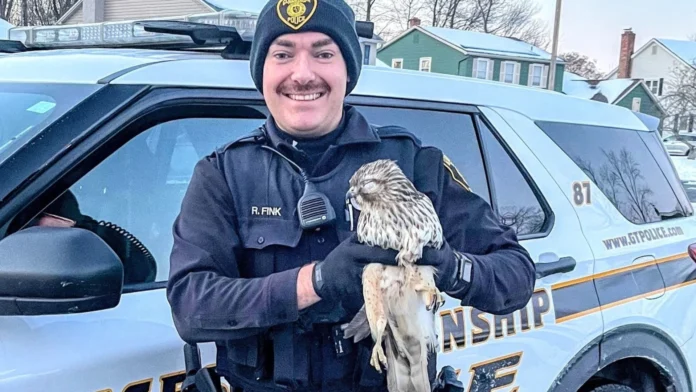
Firefighters from Gloucester Township were dispatched after residents reported a loud impact and shattered glass inside their home. When responders arrived, they discovered a visibly stunned hawk on the floor, wings spread and clearly unable to take flight. The bird had struck the window at full speed, a common but often fatal hazard for raptors navigating increasingly dense residential and commercial development.
Rather than treating the scene as an unusual curiosity, firefighters immediately shifted into rescue mode. Using protective equipment and careful handling techniques, they secured the bird, created a temporary safe enclosure, and ensured the hawk was protected from further stress while wildlife professionals were contacted.
Within hours, photos of the rescued hawk—alert, sharp-eyed, and unmistakably fierce despite its injuries—began circulating online. The bird was quickly dubbed “Hank” by residents and emergency personnel, and the story spread rapidly across social media, where neighbors shared updates, messages of concern, and admiration for the first responders who acted with patience and care.
But behind the viral moment is a far more serious reality.
Window strikes are now one of the leading causes of injury and death for birds in urban and suburban environments. Raptors such as red-tailed hawks rely on high-speed flight and visual targeting to hunt. Large reflective glass surfaces, especially those that mirror trees or open sky, can appear invisible to birds in pursuit of prey. Gloucester Township, like many South Jersey communities, sits along established migratory corridors and provides abundant hunting grounds for birds of prey—making collisions an unfortunate and recurring risk.
Hank’s survival immediately after the impact is notable. Raptors that strike glass at full speed often suffer internal injuries, head trauma, or fractures that are not always visible to untrained observers. Firefighters followed established wildlife-response protocols by minimizing handling, reducing noise and light exposure, and arranging rapid transfer to licensed wildlife rehabilitators equipped to assess and stabilize the bird.
Veterinary professionals who routinely treat window-strike victims explain that the first 24 to 48 hours following impact are critical. Birds may appear alert but still be experiencing brain swelling, vision impairment, or internal bleeding. Specialized avian care is often the difference between release back into the wild and permanent disability.
For Gloucester Township residents, the rescue became an opportunity to learn more about the wildlife that quietly shares their neighborhoods. Red-tailed hawks are among New Jersey’s most adaptable raptors, thriving in open fields, wooded edges, highway corridors, and suburban landscapes. They serve an important ecological function by controlling rodent populations and maintaining balance in local food webs. Seeing one up close—especially in a vulnerable moment—reminded many residents that these powerful birds remain deeply affected by human-built environments.
The firefighters involved in Hank’s rescue emphasized that responding to wildlife incidents has become a regular part of modern emergency service. From deer trapped in fencing and owls tangled in netting to turtles struck by vehicles, local fire departments increasingly serve as the first line of assistance when animals are in distress. Many departments now receive basic wildlife-handling training and maintain direct partnerships with regional rehabilitation centers.
In this case, that coordination ensured Hank was transferred quickly to professional care, where trained rehabilitators could evaluate the bird for neurological trauma, wing and talon injuries, and long-term flight readiness.
As updates on Hank’s condition circulated, the story drew attention to the broader network of wildlife professionals and volunteers who operate quietly throughout the state. New Jersey is home to dozens of licensed wildlife rehabilitation facilities and hundreds of trained volunteers who provide medical treatment, rehabilitation, and release services for injured, orphaned, and displaced animals. Their work is often supported through donations, community fundraising, and partnerships with municipalities and animal control offices.
Hank’s rescue also prompted renewed discussion about how residents can reduce collision risks around their own homes. Simple changes—such as installing bird-safe window decals, applying external screens, using ultraviolet-patterned glass treatments, or adjusting nighttime lighting—can dramatically lower the chance of fatal strikes. Landscaping choices that avoid placing bird feeders directly in front of large glass surfaces can also reduce high-speed approach angles.
For wildlife advocates, stories like Hank’s offer an accessible entry point into a much larger conversation about humane coexistence with animals in an increasingly developed state. As New Jersey continues to build upward and outward, balancing growth with conservation requires not only policy but daily awareness at the community level. It is a theme increasingly reflected across the state’s expanding focus on animal welfare, conservation, and compassionate environmental stewardship highlighted through Explore New Jersey’s coverage of humane and wildlife protection efforts.
What made Hank’s story resonate so deeply is not simply that a hawk was rescued. It is that the rescue unfolded in real time, in a family’s living room, and was handled with professionalism and empathy by public servants whose primary mission is human safety—but who recognized that protecting wildlife is part of protecting the community as a whole.
Residents who witnessed the rescue described a powerful sense of connection as firefighters gently secured the bird, shielding it from curious onlookers and the cold winter air. Children in the neighborhood watched quietly from their front steps, asking questions about hawks, migration, and whether Hank would be able to fly again. In a moment of chaos caused by shattered glass and flashing lights, education and compassion unexpectedly took center stage.
While officials have not released detailed medical updates, wildlife rehabilitators note that red-tailed hawks have a strong track record of recovery when treated promptly after collisions. If neurological symptoms resolve and flight strength can be fully restored, birds like Hank can often be released back into suitable habitat within weeks.
For Gloucester Township, the small celebrity hawk has already left a lasting impression. The incident reinforced the importance of rapid reporting when wildlife appears injured, the value of trained emergency responders who treat animal calls seriously, and the role every resident plays in creating safer spaces for native species.
In the end, Hank’s sudden encounter with a window became something far larger than a rescue call. It became a reminder that New Jersey’s neighborhoods remain part of a living ecosystem—and that even in the most ordinary places, compassion, preparation, and community cooperation can give wildlife a second chance to return to the sky.