- This event has passed.
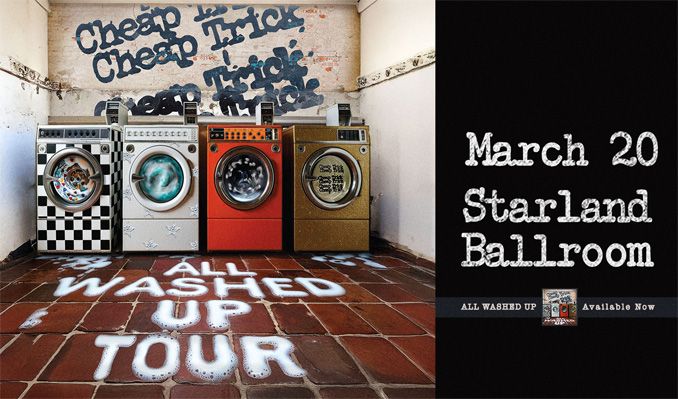
WRAT and WDHA Present Cheap Trick with James Hatem
Fifty Years Loud: Why Cheap Trick’s Relentless Drive Still Defines American Rock—and Why New Jersey Has Always Been Part of the Story
March 20 @ 17:00 – 23:30
As Cheap Trick moves toward its 50th anniversary milestone, the band’s legacy is no longer just a matter of hit singles, chart placements, or platinum plaques. It has become something far more enduring—a blueprint for how American rock bands survive, evolve, and stay culturally relevant without sacrificing identity. For fans across New Jersey, where live music loyalty runs deep and classic touring acts remain central to the state’s concert culture, Cheap Trick’s longevity is not simply impressive. It feels personal.
Few bands can claim to have built a sound so instantly recognizable that a single chord change, a vocal inflection, or a jagged guitar figure immediately signals who is playing. Cheap Trick’s unique blend of melodic precision, power-pop craftsmanship, and arena-sized guitar punch created a lane that countless artists would later follow. But what truly sets the Rockford, Illinois-born quartet apart is not just how influential they became—it is how stubbornly alive their creative engine has remained.
From the beginning, Cheap Trick was never content to exist inside one musical box. The band’s original lineup—Robin Zander on vocals and rhythm guitar, Rick Nielsen on lead guitar, Tom Petersson on bass, and Bun E. Carlos on drums—approached songwriting with a rare balance of humor, vulnerability, and razor-sharp structure. Their early material married teenage urgency with grown-up musicianship, blending British Invasion melodies, American hard rock muscle, and pop sensibility into a sound that was simultaneously clever and explosive.
That duality became the backbone of Cheap Trick’s rise. When the group formally came together in the mid-1970s and began performing relentlessly throughout the Midwest, their reputation as a live act spread quickly. Early showcases revealed a band that could move seamlessly between aggressive riffs and hook-heavy choruses without ever sounding calculated. That organic tension between bite and beauty would later define their catalog.
Their self-titled debut in 1977 quietly laid the groundwork for what would become one of the most distinctive bodies of work in modern rock history. Though it initially slipped under the mainstream radar, songs such as “He’s a Whore,” “Oh, Candy,” and “Elo Kiddies” became cult favorites among musicians and tastemakers, admired for their fearless structures and sharp lyrical personality. Within months, the band returned with In Color, a record that refined their melodic instincts and opened the door to their first major international breakthrough.
It was in Japan, however, where Cheap Trick’s global identity was truly forged. The explosive response from Japanese audiences during their 1978 concerts at Tokyo’s Nippon Budokan elevated the band into a phenomenon. The resulting live album, recorded in front of deafeningly devoted crowds, became an unexpected cultural earthquake back in the United States. Imports of the album circulated rapidly among American fans before the record label moved to release it domestically, and Cheap Trick at Budokan quickly transformed from a regional success story into a national obsession.
For many listeners, that live album remains the moment Cheap Trick crossed from promising rock band into permanent fixture of American music. The energy, precision, and playful swagger captured on those recordings turned songs like “I Want You to Want Me” into generational anthems and set a new standard for how live rock albums could translate urgency into the living room.
The momentum carried directly into Heaven Tonight, the album that delivered “Surrender,” a song that would become one of the most defining youth anthems of the late twentieth century. Its brilliance lies not only in its sing-along chorus, but in its narrative subtlety—a coming-of-age reflection disguised as a power-pop singalong. Decades later, it still resonates with listeners navigating identity, rebellion, and self-acceptance.
By the time Dream Police arrived, Cheap Trick had expanded its sonic reach without losing its mischievous core. Sweeping arrangements, layered harmonies, and more adventurous production revealed a band comfortable with experimentation, even as their music continued to dominate radio playlists and arena stages. That creative confidence allowed them to avoid the stylistic stagnation that derailed many of their peers.
The early 1980s marked another pivotal chapter. Working with legendary producer George Martin and engineer Geoff Emerick, Cheap Trick pushed further into melodic complexity and studio sophistication. Rather than distancing fans, the evolution strengthened the group’s reputation as musicians willing to challenge themselves and their audience. They were no longer simply riding a sound—they were refining a language.
The late 1980s brought one of the most commercially visible peaks of their career with Lap of Luxury. Anchored by “The Flame,” the band achieved its first number-one single, introducing Cheap Trick to an entirely new generation of listeners while reaffirming their place in mainstream pop culture. Yet even at the height of chart success, the group resisted becoming defined solely by radio metrics. Touring never slowed. Songwriting never stopped.
That constant forward motion became their defining trait. Through the 1990s and into the 2000s, Cheap Trick’s influence quietly expanded across alternative rock, pop-punk, and power-pop revival scenes. Artists spanning multiple generations—from garage revivalists to stadium-filling alternative acts—publicly cited the band as a primary creative reference point. Their ability to balance distortion with melody became a template for bands trying to reconcile aggression with accessibility.
Personnel changes never fractured the group’s identity. When drummer Daxx Nielsen joined the lineup in the 2010s, the transition felt less like a reinvention and more like a continuation of an inherited musical philosophy. The release of Bang, Zoom, Crazy…Hello reaffirmed Cheap Trick’s refusal to age out of relevance. The album felt playful, loud, and unpretentious—a direct extension of the band’s original DNA.
Recognition finally arrived in institutional form when Cheap Trick was inducted into the Rock and Roll Hall of Fame. The honor, while long overdue, simply confirmed what fans had known for decades: this was a band that shaped modern rock songwriting without ever demanding critical permission to do so.
Yet what may be most remarkable is how Cheap Trick has continued to treat recording and touring as equally essential parts of their identity. Their twentieth studio album, In Another World, released more than four decades after their debut, charted impressively and was widely praised for its energy and clarity of vision. Produced with contemporary polish but unmistakably rooted in classic Cheap Trick grit, the album demonstrated that the band remains capable of creating new material that stands comfortably beside their most celebrated work.
For New Jersey fans, Cheap Trick’s story is deeply intertwined with the culture of live performance that defines the state’s concert landscape. From legendary theaters to modern amphitheaters and festival stages, New Jersey audiences have long embraced touring acts that value musicianship, consistency, and genuine connection. The band’s relentless return to the road—often logging well over a hundred performances each year—has made them a familiar and beloved presence for local concertgoers who appreciate authenticity over nostalgia packaging.
That ongoing relationship between touring veterans and New Jersey audiences continues to fuel the state’s broader live entertainment ecosystem, which remains one of the most active in the Northeast. Readers interested in discovering how national and emerging artists continue to shape the local soundscape can explore the evolving New Jersey music scene through Explore New Jersey’s dedicated music coverage.
Approaching their 21st studio album and a global anniversary tour, Cheap Trick stands as a living contradiction to the notion that legacy acts must either reinvent themselves completely or quietly fade into heritage branding. They have done neither. Instead, they have simply kept working—writing, recording, rehearsing, performing, and laughing their way through an industry that has transformed around them.
Perhaps the band’s greatest achievement is not the number of certifications on their walls or the awards listed in their biography. It is the fact that they never allowed success to interrupt curiosity. Five decades in, Cheap Trick still sounds like a band that expects its next song to matter.
For audiences across New Jersey and beyond, that enduring sense of purpose is why Cheap Trick remains more than a legendary name on a marquee. They remain a reminder that real rock and roll—hook-driven, guitar-powered, emotionally honest, and joyfully loud—does not belong to a single era. It belongs to anyone willing to keep showing up, night after night, and playing like it still means everything.