Deadline: Submit to The MAC One-Acts 2026!
New Jersey Playwrights Take Center Stage as The MAC ONE-ACTS Festival Opens Submissions for 2026
April 12 @ 12:00
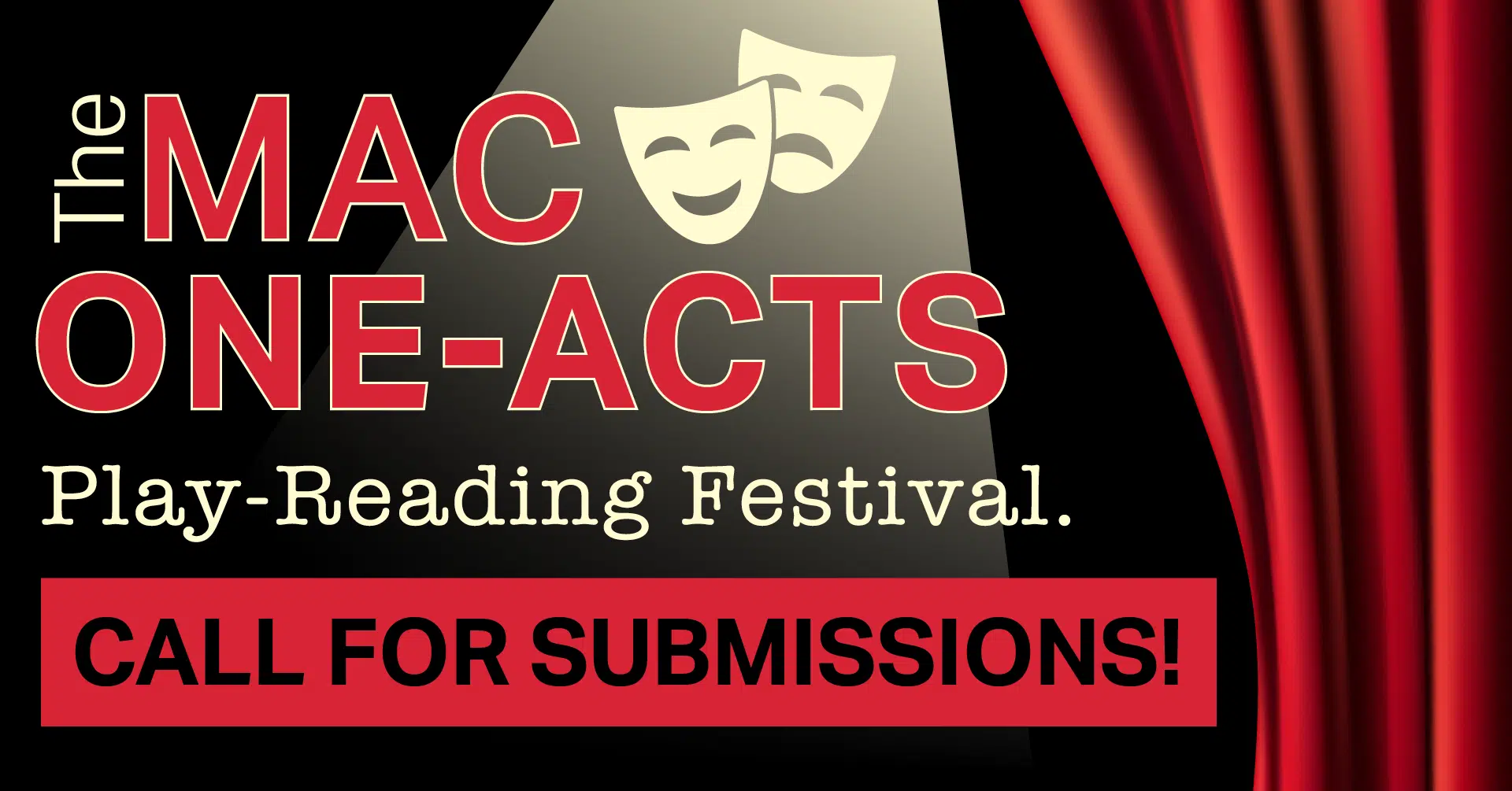
New Jersey’s theatre scene has always thrived on proximity to New York, but its true strength has never been imitation—it has been creation. Across the state, from community stages to professional venues, a distinct voice has continued to emerge, one shaped by local stories, diverse communities, and a deep-rooted commitment to the performing arts. That voice is now being amplified once again as the Middletown Arts Center officially opens submissions for the 2026 edition of The MAC One-Acts 2026 Annual Play-Reading Festival, a growing platform dedicated entirely to original work by New Jersey playwrights.
Set to culminate in a live festival performance on May 14, 2026, this year’s event marks the seventh installment of a program that has steadily become one of the most important grassroots theatre initiatives in the state. What began as a focused opportunity for emerging writers has evolved into a respected creative pipeline, connecting playwrights, actors, directors, and audiences in a way that reinforces New Jersey’s identity as a serious and self-sustaining theatre ecosystem. With submissions now open through April 12, the call is not simply for scripts—it is a call for voices, perspectives, and stories that reflect the complexity and energy of life across the Garden State.
At its core, The MAC One-Acts 2026 Festival is about access and opportunity. The parameters are intentionally designed to encourage both discipline and creativity. Playwrights must be New Jersey residents aged 18 or older, and each submission must be an original, unpublished one-act play with a runtime of no more than 30 minutes. Scripts are limited to five characters and must adhere to professional formatting standards, including a full synopsis and character breakdown. These guidelines are not arbitrary—they reflect real-world theatrical constraints, preparing writers for professional environments while ensuring that selected works are viable for staged readings and audience engagement.
The single-submission rule underscores the seriousness of the process. Writers are asked to put forward their strongest, most refined work, reinforcing the festival’s reputation as a curated, high-quality showcase rather than an open-ended reading series. The expectation that playwrights be available for rehearsals and the live event also reinforces the collaborative nature of theatre itself. This is not a remote or passive experience; it is an active, in-person creative process that brings writers into direct conversation with performers and audiences.
The timeline for this year’s festival is tightly structured, reflecting both efficiency and ambition. Submissions close on April 12 at 11:59 p.m., with finalists announced just four days later on April 16. That rapid turnaround speaks to both the experience of the selection team and the growing demand for opportunities like this within the state’s theatre community. By mid-May, selected works will be fully realized as staged readings performed by local actors inside the Middletown Arts Center’s theater, creating an immediate bridge between page and performance.
What makes this festival particularly significant within the broader New Jersey arts landscape is its positioning within a larger cultural framework. Theatre in New Jersey is not confined to a single city or venue. It exists as a statewide network of institutions, independent companies, community groups, and educational programs, all contributing to a vibrant and evolving creative economy. Platforms like the Explore New Jersey theatre section continue to highlight just how expansive that ecosystem has become, from major productions and touring shows to intimate, locally driven performances like The MAC One-Acts 2026.
Within that ecosystem, the Middletown Arts Center occupies a particularly important role. Located at 36 Church Street in Middletown, the center has established itself as a multidisciplinary arts hub, supporting visual arts, music, dance, and theatre under one roof. Its commitment to original work—especially through initiatives like The MAC One-Acts 2026—positions it not just as a venue, but as a creative incubator. For playwrights, this distinction matters. It means the difference between simply having a script read and having it developed, interpreted, and experienced in a collaborative environment that values new voices.
The emphasis on original, unpublished work is especially critical at a time when the theatre industry is actively seeking new material. While revivals and established titles continue to dominate commercial stages, there is a growing demand for fresh narratives that reflect contemporary life. New Jersey, with its unparalleled diversity and proximity to major cultural centers, is uniquely positioned to meet that demand. The stories emerging from its communities are inherently varied—urban and suburban, traditional and experimental, deeply personal and broadly social. The MAC One-Acts 2026 Festival provides a structured pathway for those stories to reach an audience.
Equally important is the accessibility of the event itself. The festival is free and open to the public, removing financial barriers and inviting a broader audience to engage with new theatre. This approach reinforces a key principle that has long defined New Jersey’s arts culture: inclusivity. By making the final performances accessible, the Middletown Arts Center ensures that the work being developed is not confined to industry insiders but shared with the community that inspires it.
For audiences, the festival offers a rare opportunity to experience theatre in its most immediate form. Staged readings strip away elaborate production elements and focus attention on the essentials—writing, performance, and storytelling. This format allows audiences to engage directly with the material, often encountering ideas and perspectives that have not yet been shaped by commercial pressures or large-scale production demands. It is theatre at its most raw and, in many ways, its most honest.
For playwrights, the impact can be far-reaching. A successful reading can lead to further development, full productions, or additional opportunities within the regional theatre circuit. It also provides invaluable feedback, both from collaborators and from live audiences, helping writers refine their work and better understand how their stories resonate in a performance context. In this way, The MAC One-Acts 2026 Festival functions as both a showcase and a stepping stone, supporting the next generation of New Jersey theatre artists.
The broader significance of initiatives like this becomes even clearer when viewed through the lens of New Jersey’s evolving cultural identity. The state is no longer defined solely by its proximity to larger markets. It is increasingly recognized as a creative destination in its own right, with a growing infrastructure that supports artists at every stage of their careers. From established theaters to emerging festivals, from educational programs to community-driven events, New Jersey is building a comprehensive arts ecosystem that reflects its diversity and ambition.
The MAC One-Acts 2026 Festival is a clear example of that momentum in action. It demonstrates how targeted, thoughtfully designed programs can have a meaningful impact on both individual artists and the broader creative community. It also highlights the importance of local investment in the arts—investment not just in buildings and programming, but in people, ideas, and opportunities.
As the April 12 submission deadline approaches, the call is clear. New Jersey playwrights have an opportunity to step forward, to contribute to a growing body of original work, and to take part in a festival that continues to shape the state’s theatrical landscape. For audiences, the promise is equally compelling: an evening of new stories, new voices, and new perspectives, all brought to life on a local stage that is increasingly gaining statewide recognition.
In a moment when the arts are redefining their place within communities, The MAC One-Acts 2026 Festival stands as a reminder of what makes theatre essential. It is not just about performance; it is about connection. It is about giving voice to stories that might otherwise go unheard and creating spaces where those stories can be shared, explored, and celebrated. In New Jersey, that mission is not theoretical—it is happening now, one act at a time.