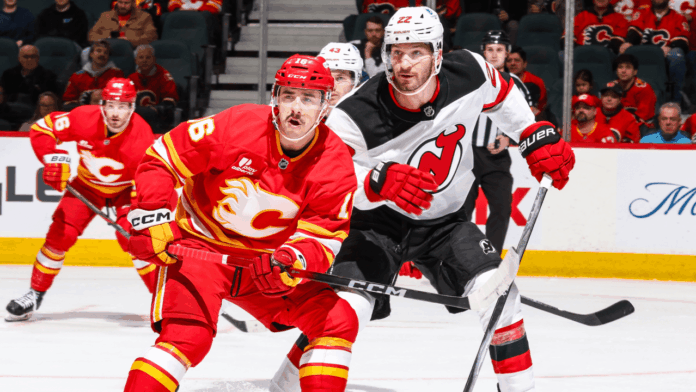

The New Jersey Devils continue to define their season far from home, and the latest stop on a demanding road trip offered both encouragement and new challenges. A gritty 2–1 overtime victory against the Calgary Flames on Monday night reinforced the team’s ability to grind out results in hostile buildings, even as the lineup absorbs the impact of key injuries. Less than 24 hours later, the Devils shift their focus to a marquee matchup against the Edmonton Oilers on January 20, a late-night test that will further reveal how resilient this group can be as the NHL calendar tightens.
Monday’s win in Calgary was not a showcase of offensive fireworks, but it was a statement in composure and execution. The Devils matched the Flames shift for shift, leaned on structured defensive play, and stayed patient until overtime opened the door for the decisive goal. In a season where points are at a premium and the Eastern Conference standings remain crowded, securing two points in that fashion carries real weight. The victory improved New Jersey’s record to 25-22-2, keeping the club firmly in the conversation as it navigates a crucial stretch of games away from Prudential Center.
That momentum now carries into Edmonton, where the Devils will face one of the league’s most explosive offenses. The Oilers present a vastly different challenge than Calgary, demanding discipline, smart puck management, and timely goaltending. A 10:00 p.m. Eastern start adds another layer of difficulty, particularly at the tail end of travel, but these are the types of games that can define a road trip and, ultimately, a season. How the Devils respond tonight will say a great deal about their readiness to compete with elite teams under less-than-ideal circumstances.
Complicating matters is the growing list of injuries impacting New Jersey’s core. Jack Hughes, one of the league’s most dynamic forwards and a constant driver of the Devils’ offense, remains sidelined with a finger injury. His absence alters the complexion of the forward group, forcing others to shoulder more responsibility in transition and on the power play. On the back end, Luke Hughes suffered a shoulder injury during the Calgary game, a blow that further tests a defense corps already asked to handle heavy minutes against top competition. Losing a young defenseman who moves the puck as confidently as Hughes is not easily absorbed, particularly on a road trip where clean exits and controlled breakouts are essential.
In the face of those challenges, leadership has become even more critical. Captain Nico Hischier continues to set the standard with his two-way commitment, anchoring matchups against opposing top lines while contributing offensively when opportunities arise. Jesper Bratt’s creativity and pace remain vital to generating chances, especially in games that trend toward tight checking. Timo Meier’s physical presence and willingness to attack the interior of the offensive zone add a dimension that can wear down opponents over the course of a road trip. Supporting pieces like Dawson Mercer and Ondřej Palát have been tasked with elevating their play, particularly as the lineup searches for consistent secondary scoring without Jack Hughes in the mix.
Defensively, the spotlight intensifies on veterans and emerging contributors alike. Dougie Hamilton’s ability to log big minutes and drive offense from the blue line becomes even more important with Luke Hughes unavailable. Simon Nemec and Jonas Siegenthaler are being asked to handle difficult assignments, often against top-tier forwards, while maintaining the structure that has kept games manageable during this trip. The margin for error against a team like Edmonton is slim, and defensive awareness will be paramount.
Between the pipes, the Devils have leaned on the experience of Jacob Markström, with Jake Allen providing support as needed. Road games often hinge on timely saves, and New Jersey’s goaltending tandem has been a stabilizing force during stretches where offense is harder to come by. Against the Oilers’ high-octane attack, early saves and rebound control could dictate whether the Devils can settle into their game or spend extended time chasing.
Beyond the immediate on-ice implications, this stretch of games fits into a broader narrative about who the Devils are becoming. This is a team balancing high expectations with the realities of injuries, travel, and a competitive conference. Wins like the one in Calgary build belief, but sustaining that belief requires consistency against a variety of opponents and styles. The ability to adapt, particularly when star players are unavailable, often separates playoff teams from those left on the outside looking in.
For fans following every development, the current road trip underscores why comprehensive coverage of the New Jersey Devils matters now more than ever. Each game connects to the next, each lineup adjustment ripples through the roster, and every point gained or lost shapes the path ahead. Tonight’s clash in Edmonton is not just another date on the schedule; it is a measuring stick for a team determined to prove it can compete, adjust, and endure.
As the Devils take the ice against the Oilers, they do so with momentum from Calgary, questions created by injuries, and an opportunity to make a statement on a national stage. Road trips have a way of clarifying identity, and this one is no exception. How New Jersey responds under the bright lights and late start will resonate beyond a single night, offering a clearer picture of where this season may be headed.
A New Name to Watch as the Devils Test Their Depth on the Road. As the New Jersey Devils continue their demanding road swing through Western Canada, the organization finds itself balancing short-term urgency with long-term development. A hard-earned 2–1 victory over Calgary has already set a resilient tone for the trip, with another challenge looming against Edmonton on January 20. Amid injuries and lineup shuffling, including the absence of key defenseman Luke Hughes, the Devils may soon turn to an unfamiliar but intriguing option up front: highly regarded rookie forward Lenni Hameenaho.
The 2023 draft pick has quietly positioned himself for this moment. While much of the attention around the Devils this season has focused on established stars and the pressure to stay competitive in the Eastern Conference race, Hameenaho’s recall from Utica represents a different storyline. It is not about instant stardom or dramatic rescue, but about whether intelligence, patience, and subtle skill can meaningfully impact a lineup that has struggled for consistent secondary scoring.
Hameenaho’s first professional season in North America has unfolded as a steady climb rather than an immediate surge. Early adjustments to the smaller ice surface and faster tempo were evident, particularly during a scoreless stretch at the start of his AHL campaign. Since then, his game has settled in. Over the past several weeks, he has emerged as one of Utica’s most productive and reliable forwards, leading the team in overall points while showing a knack for timely goals. The raw totals matter, but the context matters more: Hameenaho has been learning on the fly, adapting to a new continent, and finding his confidence against older, stronger competition.
What separates Hameenaho from many prospects is not explosive speed or a blistering shot, but a refined sense of the game. His awareness away from the puck consistently puts him in dangerous areas, particularly in the offensive zone where anticipation can be as valuable as raw power. Coaches and scouts alike have long highlighted his hockey sense, describing a player who reads pressure well, supports possession, and rarely wastes a shift chasing plays that are no longer there. Those traits tend to translate, even when minutes are limited.
That raises the central question facing the Devils’ coaching staff: where does a player like Hameenaho fit during a critical stretch of games? The top six is largely spoken for, anchored by elite skill and heavy usage. Sliding a rookie into that environment could offer immediate chemistry benefits, especially alongside creative passers who thrive on players finding open space. At the same time, top-line matchups on the road can be unforgiving, and the margin for error is thin.
The more conservative option would be to ease Hameenaho into the lineup further down the depth chart. New Jersey’s bottom six has been inconsistent, often struggling to generate sustained offense or tilt the ice in its favor. In theory, a smart, puck-supporting winger could help stabilize those lines, extend possessions, and create the occasional scoring chance that has too often been missing. The risk, however, is limiting his impact by placing him in roles that prioritize grinding over creativity, potentially muting the very instincts that make him intriguing.
Beyond deployment, Hameenaho’s arrival reflects a broader organizational philosophy. The Devils have invested heavily in drafting and development, aiming to supplement star talent with waves of cost-controlled contributors. Integrating prospects at the right time is part of that equation, particularly during stretches when injuries and schedule density test roster depth. Fans following the team’s evolution through Explore New Jersey’s ongoing coverage of the New Jersey Devils will recognize this moment as another checkpoint in that long-term plan.
No one expects Hameenaho to transform the Devils overnight, nor should that be the benchmark. His potential contribution lies in smaller details: winning a board battle that extends a shift, finding a seam that leads to a rebound chance, or making the safe play that keeps momentum alive. For a team navigating a challenging road trip and searching for balance, those details can add up.
Whether his NHL debut comes immediately or after a few more practices with the big club, Lenni Hameenaho represents a reminder that progress does not always announce itself loudly. Sometimes it arrives quietly, through a player who understands the game well enough to let it come to him. For the Devils, that may be exactly what this stretch demands.