
Eight Devils Skate on the World Stage as the Black “Jersey” Alternate Nears Its Farewell at Prudential Center
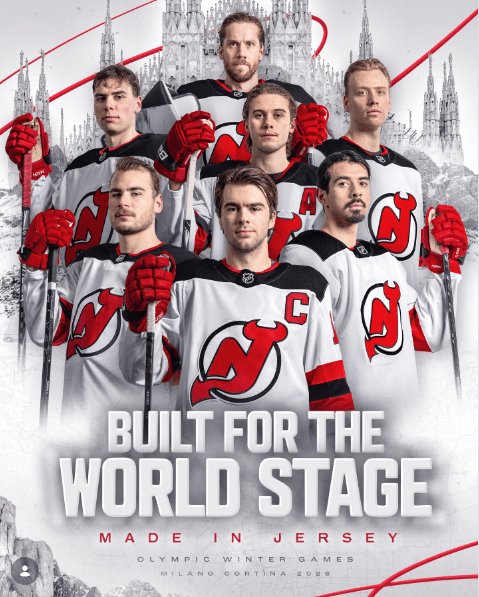
The New Jersey Devils have reached one of those rare stretches where the storylines feel bigger than the standings. In the middle of the 2025–26 season, the club is simultaneously closing the book on one of its most talked-about uniform experiments and sending a sizable contingent of players into the brightest international spotlight the sport can offer, with Olympic hockey underway in Milan-Cortina.
The result is a perfect storm for Devils fans: the pride of seeing key players represent their countries in a true best-on-best tournament, the intrigue of how those minutes and matchups might shape the second half of the NHL season, and the nostalgic edge of a “goodbye tour” for the black alternate look that has split opinion since the moment it debuted.
New Jersey’s Olympic footprint this winter is significant. Eight Devils are skating for five different countries, a reminder that the franchise has become one of the league’s most internationally diverse rosters. On Team USA, Jack Hughes steps into the tournament not only as a game-breaking talent, but as a leadership figure, wearing an alternate captain’s “A” while shouldering the kind of creative burden that can define a country’s medal hopes. Switzerland is effectively a Devils watch party all by itself, with captain Nico Hischier joined by Timo Meier and Jonas Siegenthaler, giving New Jersey fans a direct line to some of the tournament’s most compelling two-way hockey. Sweden features Jesper Bratt and goaltender Jacob Markström, while Slovakia brings defenseman Šimon Nemec into a role that could accelerate his development with heavy minutes against elite competition. Czechia’s Ondřej Palát adds experience, edge, and championship pedigree to a team built to frustrate favorites and turn close games into coin flips.
For Devils followers trying to keep up with both the NHL pause and the international schedule, this is the kind of week that turns casual fans into full-on scoreboard watchers. The tournament’s group stage format and compressed calendar mean momentum swings quickly. A hot power play, an unexpected goaltending performance, or one signature game from a star can reshape the bracket in a hurry. That’s especially true with NHL players back in the Olympics for the first time in over a decade, raising the overall level and pushing every lineup decision, matchup, and special teams unit under a microscope.
Team USA’s Olympic debut today adds an immediate pulse to the day for Devils fans. The Americans open their tournament against Latvia at 3:10 p.m. Eastern, with the game airing on USA Network and streaming on Peacock. On paper, it’s a matchup the U.S. is expected to control, but Olympic hockey has a long history of punishing teams that treat early games like formalities. Latvia is disciplined, opportunistic, and capable of turning a tight first period into a frustrating grind, which makes puck management, patience, and special teams execution essential. For Devils fans, the spotlight naturally shifts to Jack Hughes and how he navigates the tournament’s intensity, larger ice dynamics, and the pressure of being one of the players opponents game-plan around.
Switzerland’s Devils trio may be the most intriguing storyline from a New Jersey perspective. Hischier captaining a national team in a best-on-best event is a major moment for the franchise and the player, and it’s also the type of responsibility that can sharpen a leader’s game when the NHL schedule resumes. Meier’s blend of power and shot volume can change games in a hurry, while Siegenthaler’s steady defensive presence becomes even more valuable against elite top lines. If Switzerland makes a deep run, it won’t be because they got lucky; it will be because they can defend, counter, and capitalize—exactly the kind of identity Devils fans want to see translate back into their NHL season.
Sweden’s inclusion of Bratt and Markström creates another compelling layer. Bratt’s speed and creativity can thrive in international play, where time and space appear in different pockets than in the NHL. Markström, meanwhile, represents a potential swing factor at any tournament: a goaltender who can steal a game and quiet a crowd, or a goalie who gets tested early and faces a storm. If Sweden goes on a run, don’t be surprised if it’s because their structure tightens and their netminding holds.
Then there’s Nemec, whose Olympic opportunity could be quietly massive. Young defensemen often take a major leap when they get thrown into a tournament environment where every shift matters and every mistake is magnified. The experience of playing against world-class forwards, managing the pace, and handling late-game situations can compress months of learning into a week. Devils fans have watched plenty of prospects develop in real time; Olympic pressure is a different kind of accelerator.
Back home in Newark, another storyline is unfolding with more symbolism than statistics: the Devils are in the final season of their polarizing black alternate uniforms, widely nicknamed the “Jersey” jersey. Love it or hate it, it became a lightning rod in the NHL’s modern uniform era—instantly recognizable, heavily debated, and inevitably tied to specific seasons and memories for fans who wore it proudly or couldn’t wait to see it gone.
This year is the farewell lap. The Devils are expected to retire the black alternate after the 2025–26 campaign, with the final scheduled appearance set for Sunday, April 12, 2026, when New Jersey hosts the Ottawa Senators in the regular-season home finale. For collectors, it’s a last call. For fans who embraced the look, it’s the final chance to see it on the ice as a living part of the Devils identity. For those who never warmed to it, it’s the end of a design era that stood out by doing something very different—especially in a league where tradition tends to win most uniform debates.
Part of what made the jersey notable wasn’t just the bold “Jersey” wordmark; it was the internal symbolism built into the striping, including references to New Jersey’s counties and the franchise’s retired numbers. Whether or not fans loved the aesthetic, the concept tried to pull state identity into the uniform in a way most alternates only gesture toward. In that sense, it served its purpose: it got people talking, it sold, and it made the Devils visually distinct on nights it was worn.
Looking ahead, the next uniform chapter is already the subject of speculation. The Devils are expected to unveil a new alternate for the 2026–27 season, one rumored to carry a “Hometown Remix” concept that could pull from New Jersey culture and Devils history in a fresh way. If the franchise gets it right, it becomes more than merch—it becomes an instant visual tradition tied to a new era of the team.
Between the Olympics and the uniform farewell, Devils hockey currently feels like it’s being experienced on two stages at once: the global arena of Milan-Cortina and the local heartbeat of Prudential Center. For fans, it’s an unusually rich midseason moment, where the future, the present, and the identity of the team are all in motion at the same time.
For more Devils and statewide coverage tied to the game at every level—from pro storylines to the broader culture around the sport—readers can explore ongoing reporting in Explore New Jersey’s hockey coverage.
As the Olympic tournament accelerates and the NHL schedule waits on the other side, Devils fans are watching more than just highlights. They’re watching leadership take shape, chemistry form in real time, and a franchise’s modern era come into focus—one international shift and one last black “Jersey” jersey night at a time.
The schedule for Group Stage is as follows:
Feb 11:
- Slovakia v. Finland, 10:40 AM EST (local time 16:40)
- Sweden v. Italy, 3:10 PM EST (local time 21:10)
Feb 12:
- Switzerland v. France, 6:10 AM EST (local time 12:10)
- Czechia v. Canada, 10:40 AM EST (local time 16:40)
- Latvia v. United States, 3:10 PM EST (local time 21:10)
- Germany v. Denmark, 3:10 PM EST (local time 21:10)
Feb 13:
- Finland v. Sweden, 6:10 AM EST (local time 12:10)
- Italy v. Slovakia, 6:10 AM EST (local time 12:10)
- France v. Czechia, 10:40 AM EST (local time 16:40)
- Canada v. Switzerland, 3:10 PM EST (local time 21:10)
Feb 14:
- Sweden v. Slovakia, 6:10 AM EST (local time 12:10)
- Germany v. Latvia, 6:10 AM EST (local time 12:10)
- Finland v. Italy, 10:40 AM EST (local time 16:40)
- United States v. Denmark, 3:10 PM EST (local time 21:10)
Feb 15:
- Switzerland v. Czechia, 6:10 AM EST (local time 12:10)
- Canada v. France, 10:40 AM EST (local time 16:40)
- Denmark v. Latvia, 1:10 PM EST (local time 19:10)
- United States v. Germany, 3:10 PM EST (local time 21:10)