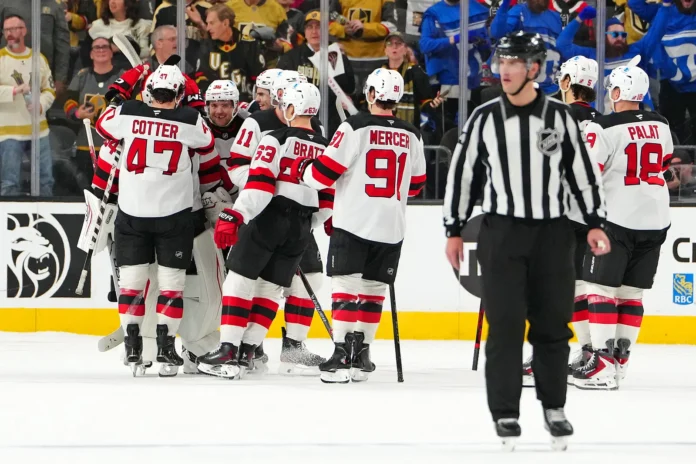

The New Jersey Devils have begun to resemble themselves again. Key pieces are filtering back into the lineup, the bench is no longer stitched together with emergency call-ups, and the organization can finally see the outline of what its true roster is supposed to look like. Yet just as stability returns on the ice, a far more complicated problem is coming sharply into focus behind the scenes. The Devils are approaching a financial choke point that will force a significant roster decision sooner rather than later.
The return of Jack Hughes, Timo Meier, Arseny Gritsyuk, and Brett Pesce has helped normalize the lineup after weeks of patchwork hockey. Hughes immediately made his presence felt by opening the scoring in his first game back, while Pesce has quietly provided the kind of defensive reliability that has been sorely needed on the blue line. The structure of the team looks far more recognizable now, but the cost of restoring that structure is that New Jersey is operating at the absolute ceiling of the NHL salary cap.
At the moment, the Devils are skating on razor-thin financial margins. With a full active roster in place, their remaining cap space barely registers. Several players remain sidelined, and their temporary replacements have allowed the team to remain compliant. That balance will disappear as soon as those injured players are cleared to return, particularly when Johnny Kovacevic is ready to rejoin the lineup. His contract alone swings the Devils from barely legal to meaningfully over the cap, and league rules do not permit healthy players to be parked on injured reserve to avoid financial consequences.
This is the pivot point in New Jersey’s season. The front office must soon decide which contract is sacrificed to preserve roster legality, and the list of realistic options is narrower than it may appear.
Veteran contracts sit at the top of the speculation ladder. Ondrej Palat and Dougie Hamilton are the most obvious names to surface whenever cap pressure becomes a topic in Newark. Both carry significant cap hits, and both would immediately solve the Devils’ financial problem if moved. Hamilton, in particular, has been quietly floated in trade discussions in the past, and his departure would also ease congestion among New Jersey’s right-handed defensemen. The complication, of course, lies in their contractual protections, which limit how easily either player can be moved.
A more flexible path could come through Stefan Noesen. His deal is far more manageable, and his partial trade protection still leaves a wide pool of potential destinations. Moving Noesen would not create massive surplus space, but it would provide meaningful breathing room while allowing the Devils to replace him with a minimum-salary forward. The return would likely be modest, yet the true value of such a deal would be financial flexibility rather than draft capital.
Jonas Siegenthaler presents a more complex decision. His tenure in New Jersey has been marked by swings in form, but his chemistry with Kovacevic last season produced one of the league’s more effective shutdown pairings. If the Devils believe that pairing can be recreated, moving Siegenthaler may feel counterproductive. On the other hand, his contract is movable, his trade protection is limited, and there would almost certainly be interest across the league. He represents a middle-ground option: a meaningful cap fix that does not dismantle the core of the team.
More drastic possibilities exist, but they drift into dangerous territory. Dawson Mercer and Cody Glass could both be moved without contractual barriers, and their salaries would create immediate compliance. The problem is that New Jersey’s offense has already struggled for consistency, and subtracting players who contribute tangible scoring depth risks compounding that weakness. These are moves that solve a financial problem by potentially creating a competitive one.
What makes this situation particularly delicate is timing. The Devils are finally regaining lineup continuity, and the internal chemistry that has been missing for weeks is beginning to reappear. Disrupting that momentum could undercut the very stability that has recently returned to the club. Yet there is no avoiding the arithmetic. When Kovacevic is ready, a contract must go.
This looming decision will shape not only the rest of the season but the structure of the Devils’ blue line and middle-six forward group for years to come. Tom Fitzgerald has positioned New Jersey as a contender with an aggressive contract philosophy, and now that approach has reached its natural stress test. The organization must thread a narrow needle between remaining competitive and remaining compliant.
For continued coverage of roster developments, financial implications, and in-depth Devils analysis, readers can follow ongoing reporting in the team’s dedicated section at New Jersey Devils coverage.
The Devils are healthier. They are more structurally sound. But they are also financially boxed in. The next roster move will not be about improving the team—it will be about preserving it.