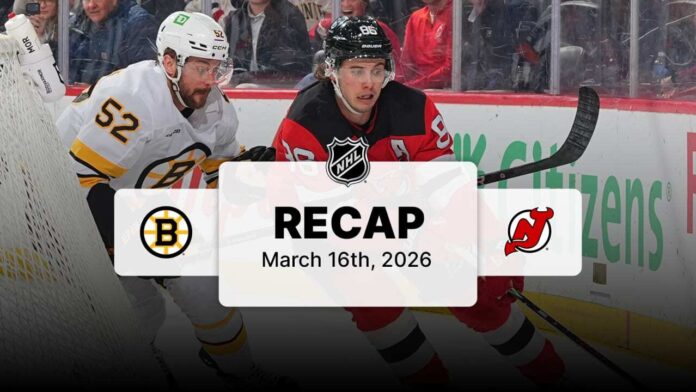

In a season that has tested resilience, identity, and consistency, the New Jersey Devils delivered one of their most compelling performances of the year on March 16 at Prudential Center—a dramatic 4-3 overtime victory against the Boston Bruins that reminded fans exactly what this roster is capable of when everything clicks.
For a team that has spent much of the season battling adversity and falling short in critical moments, this was not just a win—it was a recalibration. It was speed, skill, and belief, all resurfacing at once in front of a home crowd that has been waiting for a night like this.
The game didn’t begin with promise. In fact, it followed a script that has become all too familiar. Early defensive lapses and a costly rebound allowed David Pastrnak to strike just over four minutes into the game, giving Boston an early edge. As the period wore on, former Devil Pavel Zacha capitalized on a breakdown to extend the Bruins’ lead to 2-0.
At that point, the weight of the season seemed ready to settle in again. The Devils have struggled to climb back from deficits, particularly multi-goal ones, and the early energy inside the building began to shift.
But something changed.
What followed was not just a comeback—it was a reassertion of identity.
The second period opened with urgency, and within seconds, the Devils found their spark. Connor Brown ignited the rally with a breakaway goal just 32 seconds in, slicing through Boston’s defense and resetting the tone of the game. Suddenly, the pace quickened. The Devils were no longer reacting—they were dictating.
That momentum carried forward as Jesper Bratt delivered one of the night’s most technically precise finishes, converting a perfectly timed pass into a one-timer that tied the game at 2-2. It was a sequence that showcased the kind of offensive fluidity that defined the Devils at the start of the season—quick transitions, sharp passing, and decisive execution.
Then came the emergence of a difference-maker.
Paul Cotter, who had been working to rediscover his scoring rhythm, stepped into the spotlight in a major way. Early in the third period, he gave New Jersey its first lead of the night, finishing a play that highlighted both positioning and instinct.
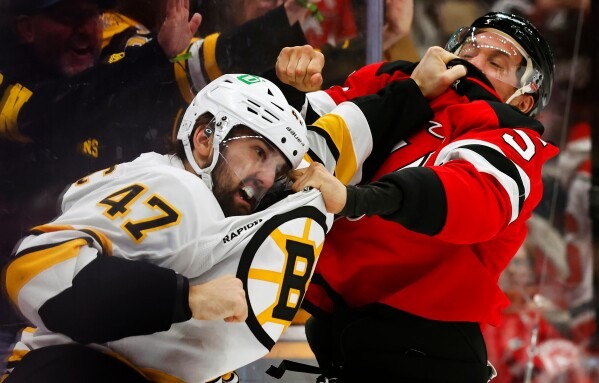
Boston responded quickly, with Pastrnak striking again to level the game at 3-3, setting the stage for a physical and emotionally charged final stretch. The Bruins, fighting for playoff positioning, leaned into a more aggressive approach, attempting to impose their will through contact and pressure. The Devils, however, didn’t fold. They absorbed it, matched it, and pushed back.
Goaltender Jacob Markstrom, despite a shaky start, steadied his performance when it mattered most, while the defensive unit held firm under increasing pressure. One of the most pivotal moments came late in regulation when Charlie McAvoy came within inches of ending the game, only to see his shot ring off the post.
That miss proved decisive.
Overtime brought a different kind of tension—open ice, heightened stakes, and the understanding that one mistake would end it. With seconds ticking down, the Devils executed one of their cleanest transition sequences of the night. Dougie Hamilton won a critical puck battle, feeding Jack Hughes, who immediately recognized the opportunity developing up ice.
Hughes, who quietly orchestrated the offense all night with three assists, delivered a perfectly weighted pass to a streaking Cotter, who broke in alone and finished with precision past Joonas Korpisalo.
With just 6.2 seconds remaining in overtime, the Devils had completed the comeback.
For Cotter, it was a defining performance—two goals, including the game-winner, marking his third multi-goal outing with the team and signaling a potential turning point in his individual season. For Hughes, it was another example of elite playmaking, reinforcing his role as the engine that drives New Jersey’s offensive identity.
More broadly, the win offered a glimpse of what this team was projected to be: fast, creative, and unafraid.
It also underscored a critical dynamic within the Eastern Conference landscape. While the Bruins entered the game fighting for postseason positioning, the Devils embraced the role of disruptor—demonstrating that even outside the playoff picture, they remain a team capable of influencing outcomes and challenging contenders.
For fans and observers across New Jersey, this performance carries weight beyond the standings. It reflects the kind of hockey that has energized the state’s fanbase in recent years—high-tempo, skill-driven, and emotionally engaging. It’s the brand of play that continues to anchor the Devils’ identity within New Jersey’s broader sports culture, which thrives on passion, resilience, and moments that feel larger than the game itself.
Looking ahead, the Devils now shift their focus to one of the most anticipated matchups on their schedule—a rivalry clash against the New York Rangers at Madison Square Garden. The Hudson River rivalry always carries added intensity, and with both teams navigating challenging seasons, the next meeting presents another opportunity for New Jersey to assert itself.
Their previous encounter—a decisive 6-3 victory powered by a Jack Hughes hat trick—serves as a reminder of what this team can do when it finds its rhythm.
And if the performance against Boston is any indication, that rhythm may be returning at exactly the right time.
For a season that has often been defined by frustration, March 16 in Newark offered something different: clarity, confidence, and a glimpse of a team that refuses to fade quietly.
In a league where momentum can shift in an instant, the Devils may have just rediscovered theirs.