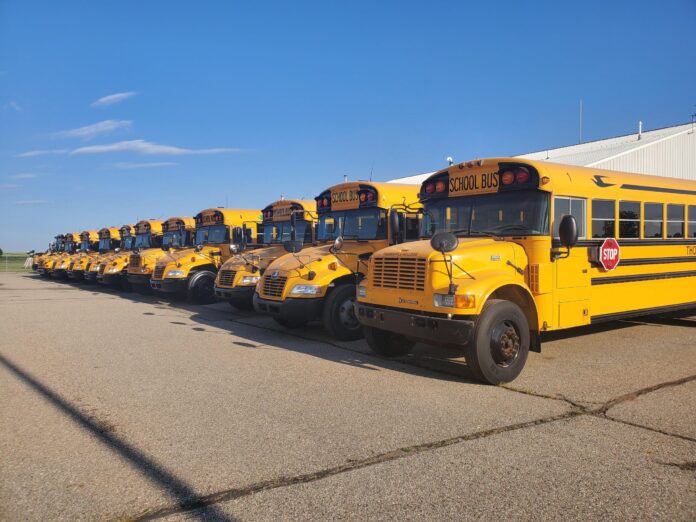

The Collingswood School District is actively exploring options to ease the travel burdens on students coming from Oaklyn and Woodlynne, whose daily commutes rank among the longest in the district. While state law requires transportation only for students who live beyond certain distances from their schools, these families fall below the mandated thresholds, leaving the district without the funding or obligation to provide courtesy shuttles. With the start of the 2026 school year on the horizon, district leaders are considering creative strategies to improve accessibility and ensure that longer travel times do not negatively affect students’ academic and extracurricular experiences.
Under New Jersey law, school districts are only obligated to provide transportation to students classified as “remote,” based on their distance from the assigned school. These requirements are outlined in N.J.S.A. 18A:39-1, which specifies that students in grades preschool through four must live more than 1.5 miles from school, grades five through eight more than two miles, and grades nine through twelve more than 2.5 miles to qualify for state-mandated busing. Students who live closer than these thresholds are considered ineligible for mandatory transportation, placing the responsibility for transit on families unless a district voluntarily provides “courtesy” or non-mandated services.
Collingswood has traditionally operated as a “walking district” for the majority of its students, providing buses primarily for special education programs or for students with disabilities. As a “receiving” district for Oaklyn and Woodlynne students, Collingswood typically relies on sending districts to fund transportation for eligible students, or provide aid-in-lieu if the cost of busing exceeds state limits. However, families of students who do not meet the remote criteria must manage longer commutes without assistance, a challenge that has prompted district officials to reconsider existing policies.
Superintendent Fred McDowell emphasized that while the district cannot currently afford to offer courtesy shuttles to all affected students, it is actively pursuing practical solutions. Discussions with municipal officials are underway to explore strategies such as staggered bus schedules, partnerships with local transit providers, and other creative approaches to reduce the impact of lengthy daily commutes. The district hopes to implement at least some of these strategies by the start of the next school year, potentially easing travel for students and their families while maintaining fiscal responsibility.
Transportation remains a critical factor in ensuring equitable access to education, and Collingswood’s ongoing review reflects a broader statewide conversation about balancing legal mandates, budget constraints, and student well-being. Families interested in understanding the full scope of New Jersey’s mandated transportation rules can find more details on the Department of Education’s official guidance.
This initiative highlights how school districts can collaborate with local municipalities and community stakeholders to address gaps in student services. For additional insights into New Jersey community initiatives, family-focused programs, and lifestyle-related resources, Explore New Jersey offers comprehensive coverage in our lifestyle section.
By exploring flexible, community-centered solutions, Collingswood is positioning itself to better support students who face long commutes, ensuring that travel logistics do not interfere with their access to high-quality education and enriching school experiences.