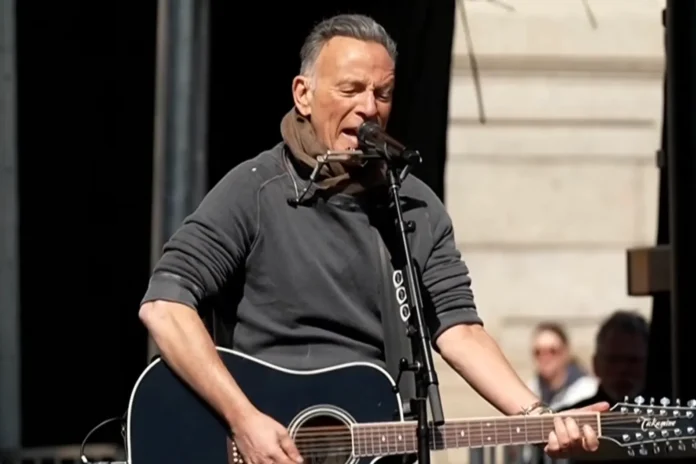

New Jersey’s most iconic voice once again stepped onto a national stage and reminded the world why his influence extends far beyond music. On March 28, 2026, Bruce Springsteen delivered a powerful live performance of his protest song “Streets of Minneapolis” before an estimated crowd of more than 200,000 people at the “No Kings” rally in St. Paul, Minnesota. The moment was not just a performance—it was a cultural flashpoint, a statement, and a defining prelude to his upcoming “Land of Hope and Dreams American Tour,” which is set to officially begin in Minneapolis on March 31.
For a state that continues to shape the national entertainment conversation, Springsteen’s presence on this stage reinforces New Jersey’s enduring cultural reach. His performance serves as both a continuation of his legacy and a reminder that artists from the Garden State remain deeply embedded in the broader dialogue shaping music, identity, and expression.
Readers tracking the pulse of live performance, artist impact, and major cultural moments can explore more through the music section, where New Jersey’s influence continues to resonate across every genre and stage.
The rally itself was part of a massive nationwide movement that brought millions into the streets across more than 3,000 coordinated events, with the Minnesota gathering serving as the flagship. Against that backdrop, Springsteen’s appearance carried a weight that extended well beyond entertainment. Taking the stage in front of a sea of demonstrators, he performed “Streets of Minneapolis,” a song written earlier this year in response to federal actions and the deaths of civilians during immigration enforcement operations in the city.
The performance was marked by both intensity and clarity, with Springsteen delivering the song in a stripped-down, emotionally direct style that emphasized its message. The inclusion of guitarist Tom Morello—long associated with politically charged music—added an additional layer of urgency and collaboration, reinforcing the moment as one rooted in both artistic expression and shared purpose. Together, they transformed the rally stage into something closer to a live broadcast of conviction, where music and message became inseparable.
For Springsteen, this was not a departure but a continuation of a career defined by engagement with the American experience in all its complexity. From the earliest days of his songwriting, he has consistently addressed themes of struggle, resilience, and justice, often reflecting the realities of working-class communities and the broader national landscape. “Streets of Minneapolis” fits squarely within that lineage, drawing on the same storytelling tradition that has defined his catalog while responding directly to contemporary events.
What makes this moment particularly significant is its timing. The performance arrives just days before the launch of a major national tour, effectively setting the tone for what audiences can expect as Springsteen returns to arenas and stages across the country. Rather than separating the live show from the cultural climate, he has chosen to integrate the two, signaling that the upcoming tour will not simply revisit past successes, but engage with the present moment in a meaningful way.
This approach aligns with the evolving expectations of live music audiences, who increasingly seek experiences that go beyond entertainment and offer a sense of connection to larger narratives. In New Jersey and beyond, the demand for concerts that carry both emotional and cultural weight continues to grow, and Springsteen’s latest performance underscores his ability to meet that demand without compromising authenticity.
The scale of the rally itself further amplifies the significance of the performance. With hundreds of thousands in attendance in St. Paul and millions participating nationwide, the event has been described as one of the largest coordinated demonstrations in recent history. (The Guardian) Within that context, Springsteen’s set functioned as both a focal point and a unifying element, bringing together diverse audiences through a shared moment of music and reflection.
At the same time, the performance highlights the enduring role of artists in shaping public discourse. In an era where platforms are fragmented and attention is constantly divided, moments like this cut through the noise, creating a shared experience that resonates across audiences and geographies. Springsteen’s ability to command that space—without spectacle, without excess—speaks to the strength of both his voice and his message.
For New Jersey, the significance is equally profound. Springsteen remains one of the state’s most recognizable cultural ambassadors, and each major moment in his career continues to reflect back on the region that shaped him. His connection to New Jersey is not merely biographical; it is embedded in the sound, themes, and perspective that define his work. As he prepares to embark on another national tour, that connection remains central to his identity as an artist.
The upcoming “Land of Hope and Dreams American Tour” now carries an added dimension, shaped by the events of March 28. What begins in Minneapolis will carry forward the energy and message established at the rally, creating a throughline between protest and performance, between moment and movement. For audiences, this represents an opportunity to witness not just a concert, but an artist actively engaging with the world around him.
As New Jersey continues to assert its presence across the national entertainment landscape, moments like this reinforce the state’s role as a source of influence, creativity, and cultural leadership. Bruce Springsteen’s performance in Minnesota was more than a headline—it was a reminder that the voice of New Jersey still carries, still resonates, and still has the power to shape the conversation on the biggest stages in the country.