
In a ballroom filled with color, concentration, and quiet bursts of excitement, Morris County transformed a milestone in American history into something families could hold in their hands, shape with their imagination, and place directly onto the map of their own community. A sold-out hands-on LEGO workshop in Morristown recently brought together parents, children, educators, and local leaders for a one-of-a-kind experience that blended creativity, collaboration, and Revolutionary War history into a powerful community moment.
The two-hour program, titled Build Our History Brick-by-Brick, served as one of Morris County’s signature public events marking the lead-up to the nation’s 250th anniversary in 2026. Fifty family teams gathered inside the Hyatt Regency in Morristown and were each challenged with an ambitious goal: recreate the town’s most historically significant sites using more than 100,000 LEGO building pieces, then assemble those models into a massive three-dimensional map of Morristown itself.
The result was not simply a craft activity or a themed family outing. It became a living, spatial history lesson—one that illustrated how deeply Morristown’s past is embedded in its present streets, neighborhoods, and civic landscape.
From the moment the first building instructions were handed out, the room took on the feel of a design studio rather than a typical workshop. Children assumed the roles of architects and engineers, parents became project managers and problem solvers, and grandparents shared stories about places they had visited for decades without fully realizing the historical significance behind them. The experience naturally bridged generations, turning well-known landmarks into shared creative challenges.
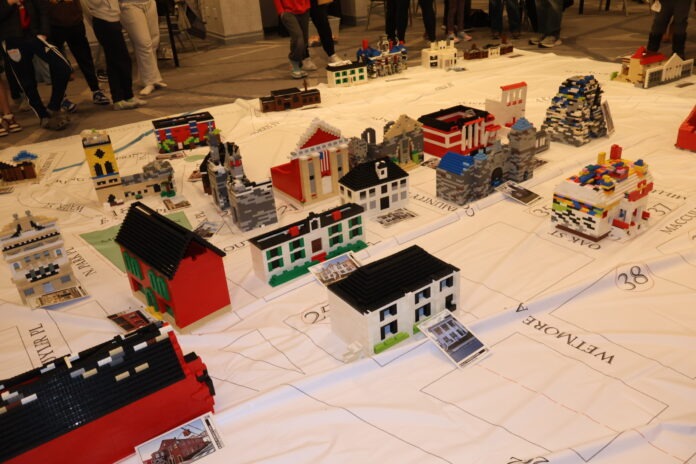
Families built detailed brick versions of some of Morris County’s most recognizable Revolutionary-era sites, including the Ford Mansion, Washington’s Headquarters Museum, Fort Nonsense, the Schuyler-Hamilton House, and the Wick House. In total, thirteen locations connected directly to the American Revolution were represented, alongside other civic and cultural landmarks that define Morristown’s historic character.
What made the project especially compelling was not just the accuracy of the models, but the way participants came to understand how these sites relate to one another geographically and historically. Morristown’s unique role as a strategic military center during two separate winter encampments of General George Washington and the Continental Army became far easier to grasp when families could literally see the town unfold beneath their hands.
As the final building sessions concluded, volunteers unrolled a massive 16-foot-by-20-foot map of Morristown across the ballroom floor. One by one, each team carried its completed structure to the correct real-world location. Slowly, a fully dimensional aerial view of the town emerged—complete with clusters of historic homes, military sites, and public buildings positioned exactly where they stand today.
The assembled display revealed something that textbooks often struggle to convey: the remarkable density of historically significant locations within a relatively compact downtown area. For many families, seeing those sites laid out together was a revelation. It highlighted how Morristown’s development, military importance, and civic life evolved side by side during one of the most consequential periods in American history.
County officials and organizers emphasized that the workshop was designed not only to educate, but to inspire curiosity beyond the event itself. The goal was to create a meaningful entry point into local history—one that encourages families to later walk the same streets, visit the same buildings, and view familiar landmarks through a much deeper historical lens.
Organizers from the Morris County 250th Anniversary Steering Committee explained that interactive, creative programming is becoming a cornerstone of the county’s broader semiquincentennial strategy. Rather than relying solely on traditional lectures or static exhibits, the county is intentionally building experiences that invite residents to actively participate in telling their own story.
That philosophy was evident throughout the workshop. Teams were encouraged to problem-solve together, adapt designs when materials ran short, and think critically about architectural features that distinguish each historic site. Even small details—window placement, roof lines, and entryways—became teaching moments about how buildings were designed for both function and symbolism during the late eighteenth century.
Local tourism leaders noted that placing the finished models directly onto the oversized map helped participants visualize how Morristown’s historic growth shaped its modern identity. The exercise demonstrated why certain corridors became centers of activity, how military logistics influenced settlement patterns, and why Morristown emerged as a focal point during the Revolutionary War years.
For many families, the workshop offered their first exposure to Morris County’s larger 250th anniversary initiative. The program is part of a multi-year public engagement effort that will continue through 2026 with educational programs, heritage tourism events, exhibitions, and community celebrations designed to highlight Morris County’s central role in the founding of the nation.
The impact of the LEGO event extended well beyond the two-hour time frame. Children left with a personal connection to sites they had just helped recreate. Parents gained new insight into local history that often gets overshadowed by broader national narratives. And educators in attendance saw firsthand how tactile learning can ignite curiosity in ways that traditional classroom instruction sometimes cannot.
The event also underscored a broader cultural shift taking place across New Jersey, where historic preservation, creative engagement, and public programming increasingly intersect. As communities search for innovative ways to keep history relevant and accessible, hands-on experiences like this one are becoming essential tools for building long-term public interest in heritage and culture. Readers interested in how these kinds of creative public programs are reshaping the state’s cultural landscape can explore more stories through Explore New Jersey’s arts and culture coverage, where similar community-driven initiatives continue to gain visibility.
Behind the scenes, the success of the workshop reflected months of planning and coordination among county leadership, tourism professionals, educational partners, and corporate sponsors who helped fund the program. Their shared objective was clear: create an experience that honors history without placing it behind glass.
By the end of the afternoon, families gathered around the finished map, pointing out their buildings, taking photos, and discussing which sites they wanted to visit next in real life. The display became a temporary community landmark of its own—an interactive snapshot of Morristown’s past reconstructed through thousands of small plastic bricks and an enormous amount of teamwork.
As Morris County continues its countdown to 2026, additional programs and public events will further explore the county’s Revolutionary War legacy and its lasting influence on New Jersey and the nation. If the enthusiasm inside that ballroom was any indication, the appetite for creative, inclusive, and deeply local history programming is only growing.
In Morristown, history was not simply remembered last weekend. It was built—piece by piece—by the very families who now carry that story forward.