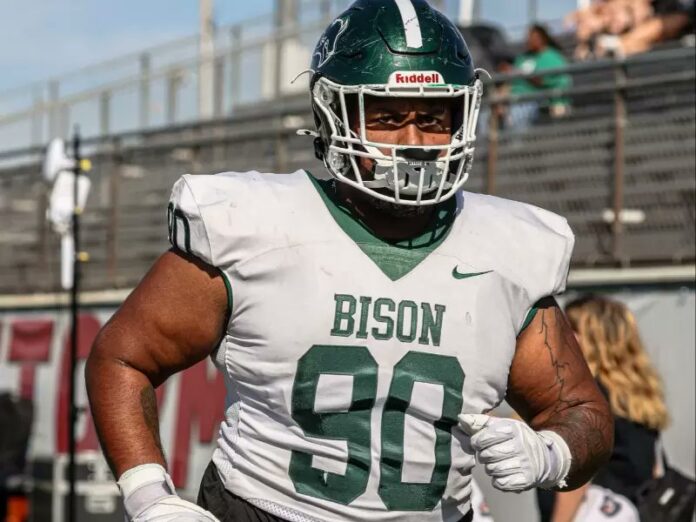

New Jersey’s football pipeline continues to assert itself on the national stage, producing athletes whose paths reflect not only talent, but resilience, adaptability, and a relentless pursuit of opportunity. From the deeply competitive high school programs across Middlesex County to the evolving collegiate landscape and beyond, the Garden State remains a consistent force in shaping the next generation of professional football players. Now, that pipeline delivers another compelling story—one that is as much about performance as it is about representation. Aditya Singh, a defensive lineman from East Brunswick, has officially signed with High Integrity Management, LLC, marking a pivotal step in his preparation for the 2026 NFL Draft and positioning himself to potentially become one of the first fully Indian-American players in NFL history.
This moment is not a starting point—it is the culmination of a progression defined by discipline and output. Singh has built his profile through sustained production, most recently at Oklahoma Baptist University, where he emerged as one of the most active and durable interior defensive linemen in his conference. His on-field workload alone underscores his reliability and conditioning, logging 710 of 793 defensive snaps over the course of the season. For a player operating in the interior, where physical collisions are constant and recovery time is limited, that level of usage is not just notable—it is a direct indicator of trust from coaching staff and a testament to physical endurance.
Standing at 6-foot and 285 pounds, Singh brings a compact, powerful build suited for interior line play, combining leverage with a high-motor approach that allows him to consistently impact the game beyond traditional stat lines. His production validated that presence, finishing the season as an All-Conference selection while leading all interior defensive tackles in total tackles within his conference. That level of activity from the defensive interior is a differentiator, signaling not only strength at the point of attack but also pursuit, awareness, and the ability to disrupt plays across multiple phases.
His journey to that breakout performance reflects a broader narrative familiar to many New Jersey athletes—one that involves movement, recalibration, and a willingness to seek the right environment for growth. Singh’s collegiate career included stops at UMass Amherst and Southern Connecticut State before arriving at Oklahoma Baptist, where system fit and opportunity aligned to unlock his full potential. Each stage contributed to his development, refining technique, expanding football IQ, and building the consistency required to transition from contributor to standout.
Recognition followed performance. Invitations to both the FCS National Bowl and the Dream Bowl placed Singh within a national evaluation pool, providing exposure to scouts, coaches, and decision-makers assessing talent for the next level. These postseason showcases are critical inflection points in a prospect’s trajectory, offering a controlled environment where performance, measurables, and adaptability are evaluated in direct comparison with peers. For Singh, they represented both validation and opportunity—a chance to demonstrate that his production translates beyond a single system or conference.
The decision to sign with High Integrity Management introduces a new phase in that progression—one centered on strategic positioning within the professional landscape. Founded by Dr. Willie Earl Fowler and based in Champaign, Illinois, the agency specializes in navigating the complexities of the NFL’s collective bargaining framework while advocating for athletes throughout the pre-draft and professional process. For Singh, this partnership is not merely administrative; it is foundational. It provides the structure, resources, and representation necessary to maximize visibility, refine messaging, and ensure that his performance is evaluated within the broader context of his trajectory.
Preparation for the draft has already intensified. Singh has been engaged in high-level training, including work with Olympic gold medalist Ato Boldon, whose expertise in speed development and performance optimization has added another layer to Singh’s preparation. Reports from within that training environment point to rapid improvement, particularly in areas that translate directly to the professional game—explosiveness off the line, lateral quickness, and sustained effort across extended series. These are the marginal gains that often separate draft selections from undrafted prospects, and Singh’s focus on refinement reflects a clear understanding of what is required at this stage.
He is now actively participating in pro days, combines, and evaluation showcases, each serving as a critical checkpoint in the lead-up to the 2026 NFL Draft. These environments demand precision, consistency, and the ability to perform under scrutiny, as every repetition is measured, recorded, and analyzed. For a player with Singh’s production profile, the objective is clear: confirm what the tape already suggests and demonstrate that his physical tools align with his on-field impact.
Yet beyond the metrics, there is a broader dimension to Singh’s pursuit—one that resonates deeply within New Jersey and across the sport as a whole. His potential to become one of the first fully Indian-American players in the NFL carries significance that extends beyond individual achievement. It represents a shift in visibility within a league that has historically lacked representation from South Asian communities. In a state as diverse as New Jersey, where football serves as both a cultural and communal touchpoint, Singh’s rise offers a tangible example of what is possible for a new generation of athletes.
Singh’s trajectory reflects that environment. It is built on the foundational principles that define New Jersey football—discipline, resilience, and an unrelenting work ethic—combined with a willingness to adapt and pursue opportunity wherever it presents itself. His path has not been linear, but it has been purposeful, each step contributing to the player he is today and the prospect he is becoming.
As the draft approaches, the evaluation process will intensify, and the margins will narrow. Teams will analyze every aspect of his profile, from physical measurements and performance metrics to film study and intangibles. For Singh, the objective is not simply to be evaluated—it is to stand out within that evaluation, to demonstrate that his combination of production, durability, and development warrants a place at the next level.
For New Jersey, his journey is both familiar and distinct. It follows the state’s long tradition of producing high-level football talent, yet it also introduces a new dimension to that legacy, expanding the boundaries of representation and redefining what the pathway to the NFL can look like. It is a story rooted in East Brunswick but reaching toward a national stage, carrying with it the weight of expectation and the promise of something larger.
Singh’s story begins in East Brunswick, where he developed his game at East Brunswick High School, a program that has steadily contributed to the region’s competitive football culture. Like many New Jersey athletes, his path was not defined by a single moment of recognition, but by sustained growth, adaptability, and the willingness to pursue opportunity wherever it emerged. That trajectory took him through multiple collegiate stops, each adding a layer to his development and refining the skill set that now defines him as a legitimate professional prospect.
His early collegiate experience at UMass Amherst placed him in a Division I environment, where the demands of high-level competition began to shape his approach to the game. From there, his move to Southern Connecticut State allowed for expanded playing opportunities and a chance to further develop his presence on the defensive line. Most recently, his transfer to Oklahoma Baptist University has positioned him in a system where performance, visibility, and preparation for the next level are closely aligned.
Now, with the 2026 NFL Draft on the horizon, Singh has taken a significant step forward by signing with High Integrity Management, a move that signals both readiness and intent. Representation at this stage is more than administrative—it is strategic. It reflects a commitment to navigating the complex transition from collegiate athlete to professional prospect with the guidance necessary to maximize exposure, refine positioning, and ultimately secure a place at the next level.
Yet what makes Singh’s journey particularly compelling is not just the progression through programs or the measurable aspects of his game. It is the broader significance of his pursuit. As he works toward entering the NFL, Singh is also aiming to become one of the first Indian-American players in league history—a milestone that carries cultural, social, and representational weight. In a sport that has historically lacked visibility for athletes of South Asian descent, his presence alone challenges long-standing narratives and opens the door for future generations.
This dimension of Singh’s story resonates deeply within New Jersey, a state defined by its diversity and its capacity to produce athletes from a wide range of backgrounds. It also aligns with the evolving identity of football at both the collegiate and professional levels, where inclusion and representation are becoming increasingly central to the sport’s future. Singh’s journey is not simply about reaching the NFL—it is about expanding what that pathway looks like and who it includes.
That culture is evident in the way New Jersey athletes approach the game. There is a distinct combination of technical discipline, physical preparation, and mental resilience that defines players coming out of the state. Singh embodies that profile. As a defensive lineman, his role demands not only strength and explosiveness but also an understanding of leverage, timing, and spatial awareness. These are not attributes developed overnight; they are the result of years of training, competition, and adaptation across multiple systems.
The decision to continue his career at Oklahoma Baptist University represents a calculated move within that framework. It provides a platform where he can showcase his abilities in a system designed to highlight defensive impact while continuing to refine the aspects of his game that translate to the professional level. For NFL scouts, versatility, consistency, and progression are key indicators—and Singh’s journey across programs offers a comprehensive view of his development in each of those areas.
As the draft cycle approaches, attention will naturally turn to measurable metrics—size, speed, strength, and production. But for players like Singh, the evaluation extends beyond numbers. It includes trajectory, adaptability, and the ability to perform within different schemes and environments. These are the qualities that often separate prospects who reach the next level from those who fall just short.
Back in New Jersey, the significance of his rise is already being felt. Young athletes across the state, particularly those from underrepresented backgrounds, now have a tangible example of what is possible. Singh’s path reinforces the idea that the journey to professional football is not linear, nor is it limited to a single route. It is built through persistence, strategic decisions, and the willingness to continue evolving.
As Aditya Singh prepares for the next phase of his career, the stakes are both personal and historic. The 2026 NFL Draft represents an opportunity to secure a place in the league, but it also represents something broader—a chance to redefine representation within the sport and to carry the legacy of New Jersey football into new territory.
The journey from East Brunswick to the professional stage is not guaranteed, and the path ahead will demand continued growth, performance, and resilience. But if Singh’s trajectory to this point is any indication, he is not approaching this opportunity passively. He is pursuing it with intention, backed by experience, and driven by a vision that extends beyond individual success.
For New Jersey, this is more than a prospect story. It is a reflection of what the state continues to produce—athletes who are not only capable of competing at the highest level, but who are prepared to redefine what that level looks like. As April turns toward the final stretch of the draft cycle, one thing is clear: Aditya Singh is not approaching this opportunity as a passive participant. He is entering it prepared, supported, and fully aware of what is at stake—not just for his career, but for the broader narrative he represents.