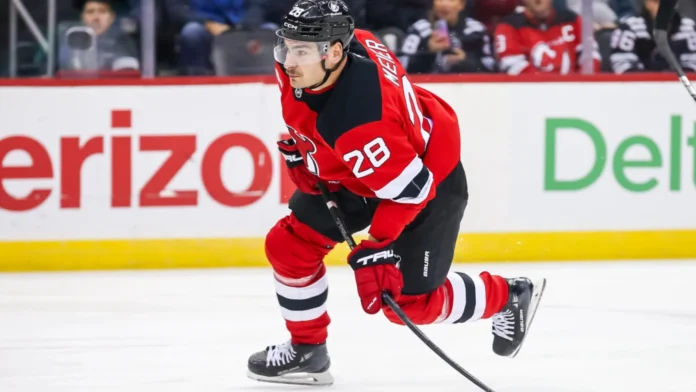

The conversation surrounding the New Jersey Devils is heating up as trade speculation, lineup adjustments, and performance expectations collide during a pivotal stretch of the NHL season. From league-wide rumors involving veteran forward Blake Coleman to growing debate over the Devils’ offensive structure and Timo Meier’s role within it, the organization finds itself at a defining moment that could shape the trajectory of its season.
As fans and analysts across the Garden State continue to evaluate the team’s direction, one central question has emerged: could a strategic shift in deployment — specifically moving Timo Meier back to the right wing — unlock the scoring potential the Devils believed they were acquiring when they made one of the franchise’s most consequential trades in recent years?
For a franchise striving to remain competitive in the Metropolitan Division and build around a dynamic core, the answers may lie not in sweeping changes, but in calculated adjustments that maximize talent already on the roster.
The Devils’ Competitive Landscape and Rising Expectations
The New Jersey Devils entered recent seasons with heightened expectations, driven by a roster built around speed, skill, and offensive creativity. With a young core anchored by elite talent and significant investments in scoring depth, the organization positioned itself as a team ready to compete consistently at the highest level.
That ambition led to the acquisition of Timo Meier at the 2023 NHL trade deadline — a move widely viewed as a signal that the Devils were entering a win-now phase. The expectation was clear: Meier’s scoring ability would elevate the team’s offensive ceiling and provide a physical, high-volume shooter capable of transforming the attack.
Following the trade, the Devils committed further by signing Meier to an eight-year contract carrying an annual value of $8.8 million, cementing his role as a cornerstone piece of the franchise’s long-term plans.
However, the results have not fully matched those expectations.
Timo Meier’s Production Under the Microscope
Since arriving in New Jersey, Meier has struggled to replicate the elite production he displayed during his tenure with the San Jose Sharks. His goal totals and overall offensive output have fallen short of the numbers that made him one of the league’s most sought-after power forwards.
Statistically, the most notable change has been his reduced shot volume — historically one of the defining elements of his game. During his peak seasons, Meier generated more than 320 shots on goal, driving offense through relentless pressure and high-frequency shooting.
In his first full season with the Devils, however, his shot totals dropped significantly. Despite incremental improvements in subsequent campaigns, his overall offensive impact has remained below expectations relative to his contract and role.
This decline has fueled ongoing debate about whether the issue stems from system fit, deployment, coaching strategy, or natural regression as he approaches his 30s.
The Olympic Performance That Changed the Conversation
Complicating the narrative around Meier’s struggles is his recent international performance representing Switzerland. During Olympic competition, Meier emerged as one of his team’s most effective forwards, recording seven points in five games and demonstrating the dynamic scoring touch that has been inconsistent at the NHL level.
Perhaps most notably, he achieved this success while playing on the right wing — the position he occupied during his most productive seasons in San Jose.
The contrast between his international performance and his NHL production has reignited discussion about how he is being utilized within the Devils’ system.
If Meier can perform at an elite level internationally, the question becomes whether structural factors within the Devils’ lineup are limiting his effectiveness.
The Case for Moving Meier to the Right Wing
A growing segment of observers believes that returning Meier to the right side could help restore his offensive rhythm. Throughout his career, he has demonstrated comfort and effectiveness playing on that side of the ice, where his shooting angles, puck control, and positional instincts appear more natural.
Despite this history, the Devils have not consistently deployed him on the right wing during his tenure in New Jersey.
From a tactical perspective, shifting Meier to his off-side or preferred side could alter offensive zone entries, improve shooting opportunities, and enhance line chemistry. Even minor positional adjustments can influence timing, spacing, and scoring chances in modern NHL systems.
Supporters of the change argue that the potential upside outweighs the risk. If the move fails to produce results, the team loses little. If successful, it could unlock the scoring impact the Devils envisioned when acquiring him.
Coaching Strategy and System Fit
The discussion surrounding Meier’s deployment also intersects with broader conversations about coaching philosophy and system design. Line combinations, positional assignments, and tactical structure play significant roles in determining player success.
Whether a coaching adjustment is necessary remains a matter of debate, but the conversation reflects a larger reality: the Devils must identify solutions that maximize their roster’s potential if they intend to remain competitive.
Modern NHL teams increasingly rely on flexibility, adjusting player roles based on performance trends and matchup considerations. Exploring alternative deployments for high-investment players is consistent with league-wide strategic evolution.
Trade Rumors and League-Wide Context
While the Devils evaluate internal adjustments, broader NHL trade speculation continues to shape the league’s competitive landscape. Discussions surrounding Calgary Flames forward Blake Coleman — along with conversations involving the Ottawa Senators, Pittsburgh Penguins, and Edmonton Oilers — highlight the fluid nature of roster construction during the season.
Although these rumors primarily involve other organizations, they underscore the constant pressure on teams like the Devils to evaluate performance, address weaknesses, and consider potential roster moves.
The NHL’s competitive environment demands adaptability, and teams unable to optimize their assets risk falling behind.
The Devils’ Offensive Identity at a Crossroads
The New Jersey Devils built their recent identity around speed, puck movement, and aggressive offensive play. When operating at full potential, the team’s system emphasizes quick transitions, high-tempo attacks, and sustained pressure in the offensive zone.
For this identity to function effectively, all key contributors must operate at peak efficiency — particularly high-profile acquisitions expected to drive scoring.
If Meier’s role can be refined to better align with his strengths, the adjustment could ripple throughout the lineup, improving overall offensive production and team performance.
Fan Expectations and Organizational Pressure
The Devils’ passionate fan base has closely followed the team’s evolution, and expectations remain high for a roster featuring elite young talent and significant financial investment.
Supporters recognize the importance of maximizing the team’s competitive window and understand that strategic adjustments often determine success in a tightly contested division.
Exploring positional changes for key players represents a proactive approach that signals organizational commitment to improvement.
A Potential Turning Point for the Season
As the Devils navigate the remainder of the season, the decision to experiment with Meier’s deployment could represent a pivotal moment. Small adjustments can produce significant results in professional hockey, where confidence, rhythm, and chemistry influence performance.
Whether moving Meier to the right wing leads to a scoring resurgence or simply provides clarity about the team’s direction, the move offers an opportunity to generate momentum.
For a franchise focused on sustained competitiveness, the willingness to adapt may prove as important as the talent on the ice.
The Path Forward for the New Jersey Devils
The New Jersey Devils remain a team defined by potential — a roster capable of elite performance yet still refining its identity. The debate surrounding Timo Meier’s role reflects a broader organizational challenge: transforming talent into consistent results.
As trade speculation continues across the NHL and the Devils evaluate internal solutions, the coming weeks could shape both the team’s immediate trajectory and its long-term strategy.
A simple positional shift may not solve every challenge, but in a league where marginal gains determine outcomes, even incremental adjustments can redefine a season.
For New Jersey hockey fans and the organization alike, the focus now turns to whether experimentation, flexibility, and strategic refinement can unlock the full potential of one of the NHL’s most intriguing teams.