
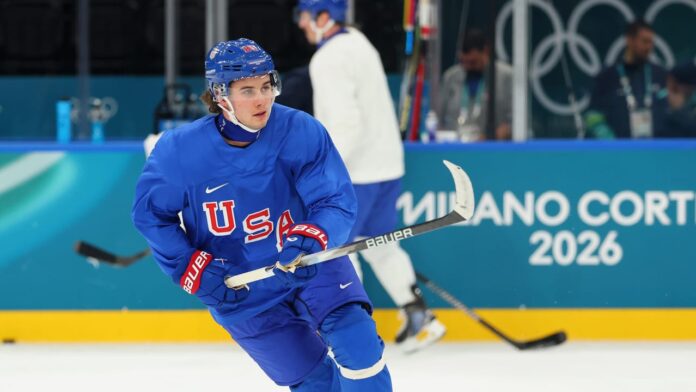

The New Jersey hockey spotlight shined brightly on the international stage Thursday afternoon, as Team USA opened its Olympic tournament in commanding fashion with a 5–1 victory over Latvia—powered in large part by a dynamic performance from New Jersey Devils franchise cornerstone Jack Hughes.
For Devils fans watching from home, the moment carried extra significance. Not only was it Hughes’ first game action in two weeks, but it also marked his return to competitive play after a lower-body injury had sidelined him for New Jersey’s final three games prior to the Olympic break. Any lingering concerns about his health or conditioning were erased almost immediately.
Despite being slotted on the fourth line to start the game, Hughes emerged as one of the most influential skaters on the ice, serving as a primary offensive catalyst throughout the Americans’ breakthrough second period and finishing the afternoon with three assists.
Two of those helpers came on Brock Nelson’s second-period goals—both created by Hughes’ elite puck movement and spatial awareness. His third assist arrived later on a power-play strike by Auston Matthews, giving Hughes a hand in three of the five American goals.
For followers of local and international hockey storylines, this performance also underscored why New Jersey players continue to play a growing role on the global stage, a theme that is being closely tracked through Explore New Jersey’s hockey coverage as Olympic competition continues to unfold.
The game itself unfolded in waves.
The United States controlled early possession and tempo, pressing Latvia’s defensive structure from the opening shift. Brady Tkachuk opened the scoring midway through the first period, but Latvia briefly stabilized the contest when Renars Krastenbergs tied the game at 1–1 later in the frame.
Even at that point, the scoreboard failed to reflect the flow of play. Two early American goals were waved off following successful Latvian challenges—one for an offside review and another for goaltender interference—allowing Latvia to escape the opening period still within reach.
That window closed decisively in the second.
Hughes became the central figure in a sequence that completely flipped the game. Circling behind the Latvian net and drawing multiple defenders toward him, he threaded a perfectly timed feed into the slot for Nelson, who buried the go-ahead goal at the 10:38 mark. The play was a textbook example of Hughes’ ability to manipulate defensive coverage with speed and deception.
Less than three minutes later, Hughes again played a critical role in a rapid passing sequence that led to Nelson’s second goal of the period, capping a stretch in which the United States scored three times and seized full control of the contest.
By the end of the second period, the Americans had built a 4–1 lead behind goals from Nelson twice and a power-play finish by Tage Thompson. Latvia, which entered the tournament with limited NHL representation, struggled to withstand the sustained pressure and was forced to replace starting goaltender Elvis Merzļikins to begin the third period.
The change in net offered little relief.
Just over two minutes into the final frame, Matthews converted a power-play opportunity to extend the margin to 5–1, with Hughes credited for the secondary assist after initiating the puck movement that opened space along the perimeter.
From that point forward, the result was academic.
For Hughes, however, the afternoon represented something much larger than a strong opening game.
The Devils center had not played since exiting New Jersey’s overtime win over Nashville in late January. During that stretch, he remained day-to-day and was not cleared by the Devils’ medical staff to return for several critical Metropolitan Division matchups. While he continued skating on his own and later with Team USA during pre-tournament practices, there was understandable curiosity about how sharp he would look in full-speed international competition.
The answer came quickly.
Hughes played with pace, confidence, and creativity, showing no hesitation in attacking defenders off the rush or cutting into high-traffic areas. His vision in transition and patience with the puck consistently pulled Latvian defenders out of position, allowing teammates to find soft ice in dangerous scoring zones.
Perhaps just as notable was the personal significance of the moment.
Sharing the Olympic stage alongside his older brother Quinn Hughes, Jack became part of a rare sibling pairing representing the United States at the highest level of international hockey. The pairing added another chapter to what has become one of the most recognizable family legacies in modern American hockey.
Quinn Hughes also factored into the scoring sequence, collecting an assist on the Matthews power-play goal and playing a steady role on the blue line throughout the game.
While Devils fans had plenty to celebrate, the Olympic picture for New Jersey-area hockey extends beyond one organization.
The Philadelphia Flyers do not have a representative on the current Team USA men’s roster, but several key Flyers players are skating for other national programs during the tournament. Travis Sanheim is competing for Canada, Rasmus Ristolainen is representing Finland, and goaltender Dan Vladar is serving as Czechia’s starting netminder in early group play.
Latvia’s roster originally included Flyers forward Rodrigo Ābols, but he was ruled out shortly before puck drop due to a late injury.
The international flavor of this tournament has been further amplified by the NHL’s temporary pause in its regular season, allowing top players from around the world to participate in Olympic competition. League play will remain on hold until February 24, keeping the spotlight squarely on Milan for the next several days.
For Team USA, the victory establishes an important early foothold in group play and provides valuable lineup clarity heading into its next matchup against Denmark. Like Latvia, Denmark enters the tournament with a limited NHL presence, though the roster does feature several recognizable names, including Frederik Andersen in goal and forwards Nikolaj Ehlers, Lars Eller, and Oliver Bjorkstrand.
Still, the central storyline for New Jersey remains unmistakable.
After weeks of cautious updates and quiet rehab, Jack Hughes returned to game action not merely healthy—but dominant. His three-assist performance did more than drive a 5–1 win. It reaffirmed his status as one of the most dynamic playmakers in the international game and offered Devils fans a reassuring preview of what awaits when NHL play resumes.
On a global stage filled with star power, it was New Jersey’s own who set the tone.
















