
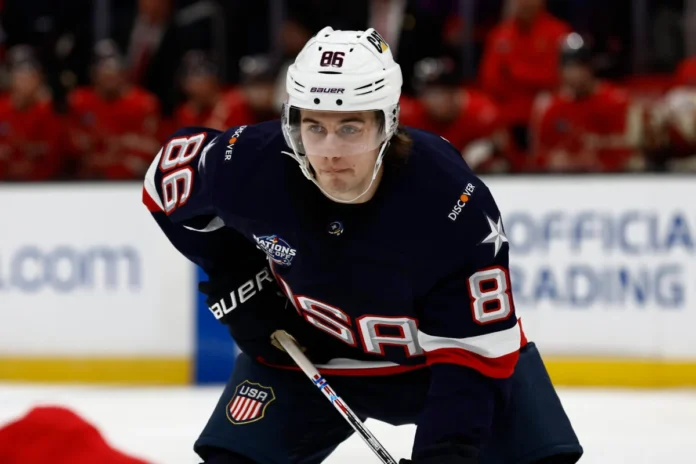

For New Jersey Devils fans, the arrival of the 2026 Winter Olympic break is more than a pause in the NHL calendar. It is a moment to take stock of a turbulent season, follow familiar faces onto the international stage, and reassess where the organization truly stands—both on the ice and behind the bench.
Eight members of the New Jersey Devils are competing in the 2026 Winter Olympics in Milan-Cortina. The men’s ice hockey tournament began on February 11, 2026, and concludes with the gold medal game on February 22.
Devils Players & Their National Teams
- USA: Jack Hughes
- Switzerland: Nico Hischier, Timo Meier, Jonas Siegenthaler
- Sweden: Jesper Bratt, Jacob Markström
- Slovakia: Šimon Nemec
- Czechia: Ondřej Palát
Preliminary Round Schedule (All Times ET)
The preliminary stage features “Devils vs. Devils” matchups, most notably a four-Devils clash between Switzerland and Czechia on February 15.
| Date | Time | Matchup | Featured Devils |
|---|---|---|---|
| Wed, Feb 11 | 10:40 AM | Slovakia vs. Finland | Šimon Nemec |
| Wed, Feb 11 | 3:10 PM | Sweden vs. Italy | Jesper Bratt, Jacob Markström |
| Thu, Feb 12 | 6:10 AM | Switzerland vs. France | Nico Hischier, Timo Meier, Jonas Siegenthaler |
| Thu, Feb 12 | 10:40 AM | Czechia vs. Canada | Ondřej Palát |
| Thu, Feb 12 | 3:10 PM | USA vs. Latvia | Jack Hughes |
| Fri, Feb 13 | 6:10 AM | Finland vs. Sweden | Jesper Bratt, Jacob Markström |
| Fri, Feb 13 | 10:40 AM | France vs. Czechia | Ondřej Palát |
| Fri, Feb 13 | 3:10 PM | Canada vs. Switzerland | Hischier, Meier, Siegenthaler |
| Sat, Feb 14 | 6:10 AM | Sweden vs. Slovakia | Bratt/Markström vs. Nemec |
| Sat, Feb 14 | 3:10 PM | USA vs. Denmark | Jack Hughes |
| Sun, Feb 15 | 6:10 AM | Switzerland vs. Czechia | Hischier/Meier/Siegenthaler vs. Palát |
| Sun, Feb 15 | 3:10 PM | USA vs. Germany | Jack Hughes |
Knockout Stage Schedule
Following group play, the tournament moves to single-elimination rounds.
- Qualification Playoffs: Tuesday, February 17 (Various times)
- Quarterfinals: Wednesday, February 18 (Various times)
- Semifinals: Friday, February 20 at 10:40 AM and 3:10 PM
- Bronze Medal Game: Saturday, February 21 at 2:40 PM
- Gold Medal Game: Sunday, February 22 at 8:10 AM
Watching the Games: All matches are available for live streaming through Peacock and Sunset, with selected games broadcast on USA Network and CNBC
As the league shuts down for Olympic competition in Milan and Cortina, the Devils enter the break searching for answers. The club sits seventh in the Metropolitan Division with a 28–27–2 record, riding a three-game losing streak and struggling to rediscover consistency in a season that was supposed to be defined by progress, not regression. A shutout loss to Columbus and a narrow defeat to the Islanders underscored the growing concern that the team’s offensive identity has eroded at precisely the wrong time.
Still, the Olympic stage provides something Devils fans rarely lack: star power in red, white, and national colors.
Jack Hughes is expected to suit up for Team USA, even after missing recent games with a lower-body injury. His presence alone keeps the Devils prominently represented during the global spotlight, while goaltender Jacob Markström will defend the crease for Sweden and captain Nico Hischier once again carries Switzerland’s hopes. For a fan base craving positive storylines, the international tournament offers a reminder that New Jersey’s core talent remains respected—and essential—on the world stage.
Back home, however, the organization continues to navigate roster and identity challenges. One of the most immediate developments heading into the break was the placement of forward Marc McLaughlin on waivers, with the intent of assigning him to the Utica Comets. After missing the entire season due to a preseason injury, McLaughlin is finally healthy and poised to resume game action, offering depth and flexibility for a system still trying to stabilize its bottom six.
While the NHL roster hits pause, the Devils’ prospect pipeline remains very active—particularly in Europe.
Few players have boosted their organizational stock more than defenseman Daniil Orlov. Skating with Spartak Moscow in the Kontinental Hockey League, the 22-year-old has quietly turned in one of the most impressive seasons by any Devils prospect overseas. With seven goals and 22 points in 51 games, Orlov earned a spot in the KHL All-Star showcase as part of the under-23 squad, producing one goal and three assists across the mini-tournament. He also finished fourth in the hardest-shot competition, registering a blistering 149.83 kilometers per hour.
For a defender whose early reputation leaned more toward mobility and transitional play, the offensive progression is significant. Orlov has grown into a confident puck-moving presence who activates more decisively in the offensive zone and shows improved composure under pressure. He remains under contract with Spartak through 2028, meaning patience will be required, but the silver lining is clear: the Devils are watching a prospect mature into a far more complete professional defender—one who could realistically step into a North American lineup as a polished product rather than a developmental project.
Across the Atlantic, development continues in Utica and Adirondack.
Winger Lenni Hämeenaho and defenseman Colton White were reassigned to the Comets to remain active during the Olympic shutdown. Hämeenaho wasted little time making an impact, collecting an assist in his return during a 5–1 loss to Rochester. Goaltender Nico Daws, meanwhile, turned aside 20 of 24 shots in that contest as the Comets continue to battle through a difficult season near the bottom of the AHL standings.
Another name steadily climbing the organizational depth chart is defenseman Jeremy Hanzel. The 22-year-old ranks second on the Adirondack Thunder in scoring with 26 points in 42 games, a notable step forward after producing 22 points in 61 ECHL games last season. Hanzel remains a long-shot NHL candidate, but his growth suggests he may deserve a closer look at the AHL level, especially as Utica searches for stability and puck movement from the back end.
In junior hockey, forward David Rozsíval continues to quietly lead the Devils’ prospect class in offensive production. Skating in the USHL, he has posted 17 goals and 28 points in 40 games, establishing himself as one of the most productive Devils-owned forwards anywhere in the system this season.
Collectively, the development picture remains far healthier than the NHL standings might suggest.
Yet no discussion surrounding the Devils’ 2025–26 campaign can avoid the uncomfortable question that now looms over the organization: is the current coaching direction fundamentally misaligned with the roster?
When Sheldon Keefe was hired as head coach in 2024, the move was widely viewed as steady and credible. His reputation was built on structure, accountability, and defensive reliability. Early returns seemed to validate the decision. New Jersey tightened its defensive play dramatically during the opening months of his tenure, including a mid-December stretch in which the team allowed fewer than 20 shots in seven consecutive games.
But that defensive discipline came at a cost.
The Devils’ offensive identity—once built on speed, controlled entries, creative puck movement and transition pressure—has steadily faded. As opposing teams gathered video and adjusted to New Jersey’s slower, more conservative approach, the goals dried up. What had initially looked like a necessary recalibration began to resemble a system that constrained the very players meant to drive the team’s success.
The core of the Devils is constructed around pace and skill. Jack Hughes, Nico Hischier, Jesper Bratt and Dougie Hamilton all produced the most dynamic stretches of their careers within an aggressive, transition-heavy framework. That identity emphasized fast breakouts, stretch passes, layered support through the neutral zone and constant pressure off turnovers.
Under Keefe, breakouts have become markedly more cautious. His emphasis on what coaches refer to as “fight the panic” prioritizes safety over speed—encouraging defenders and centers to circle back rather than forcing plays through pressure. While the philosophy can be effective for certain rosters, its fit in New Jersey has been far less convincing.
Part of that disconnect stems from personnel changes. The departures of Damon Severson and John Marino reduced the team’s overall puck-moving ability from the back end. Their replacements—Johnny Kovacevic, Brenden Dillon and Brett Pesce—bring defensive reliability, but do not replicate the same transitional efficiency. The coaching staff’s conservative adjustments may have been logical on paper.
The problem is that the payoff never fully materialized.
After Christmas last season, the Devils’ defensive numbers slipped from elite to merely solid, while offensive production continued to decline. The team narrowly reached the postseason. This year, the regression has become more pronounced. New Jersey no longer boasts top-tier defensive suppression, and the scoring drought has deepened.
Perhaps most concerning for fans is the lack of visible tactical evolution. Over the summer, management attempted to rebalance the roster by adding more speed and skill, bringing in Connor Brown, Arseny Gritsyuk, Cody Glass and Evgenii Dadonov. While not every move worked, the intent was clear: restore some offensive flexibility without abandoning defensive responsibility.
The results have not followed.
Production from the club’s most important forwards has dropped noticeably since Keefe assumed control, and the overall offensive structure remains predictable. What once felt like a transitional adjustment now resembles systemic stagnation.
The frustration intensified after a season-defining 3–0 loss to Columbus. Postgame remarks placed heavy emphasis on player execution and mental resilience. Accountability, however, appeared uneven. In a market that values transparency and leadership, fans expect a coaching staff willing to publicly acknowledge strategic shortcomings as readily as it critiques performance.
This is not an indictment of Keefe’s overall coaching credentials. His record elsewhere demonstrates that he can succeed in the right environment. But fit matters. Systems must serve rosters—not the other way around. New Jersey’s personnel is built to create offense through motion, speed and controlled chaos. The current structure suppresses those strengths without delivering elite defensive compensation in return.
As trade rumors swirl—most notably around defenseman Dougie Hamilton and a potential match with Nashville once the roster freeze lifts on February 22—the Devils appear to be drifting toward a cautious sell-side posture. Compounding the uncertainty, reports indicate that the popular black “Jersey” third uniforms will be retired after this season, with a new “Hometown Remix” alternate expected in 2026–27, symbolizing yet another quiet reset for a franchise searching for direction.
Behind the scenes, scrutiny of management has grown louder as well. Expectations were clear entering 2025–26: this was supposed to be a competitive step forward. Instead, New Jersey finds itself re-evaluating timelines, leadership decisions, and long-term strategy.
For fans, the Olympic break becomes both refuge and reflection.
It offers the chance to watch Devils stars compete on the world’s biggest stage, follow rising prospects continuing their development abroad, and reconnect with the broader excitement surrounding elite hockey. It also provides an opportunity to step back and ask difficult questions about what kind of team the Devils are trying to become.
As international play takes center stage, those looking to keep up with New Jersey’s sports scene, live events, and fan-driven experiences throughout the winter can explore ongoing coverage of entertainment and major sporting events across the state through Explore New Jersey.
When NHL action resumes, the Devils will return not only to the standings—but to a season that increasingly feels like a referendum on identity. The talent remains real. The pipeline is producing. The Olympic spotlight confirms the organization still develops players trusted at the highest levels.
What remains unresolved is whether the current blueprint truly allows that talent to thrive.
















