
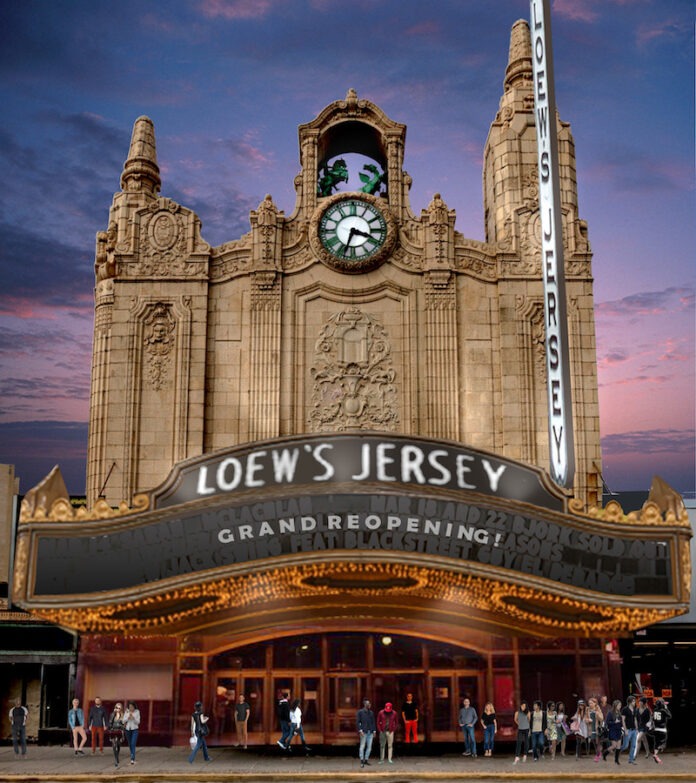

One of Jersey City’s most beloved cultural icons is officially preparing to raise its curtain once again.
After years of anticipation, restoration work, and community advocacy, the historic Loew’s Jersey Theatre is scheduled to reopen in fall 2026, bringing large-scale live entertainment back to Journal Square and reestablishing the nearly century-old venue as a cornerstone of the city’s cultural identity. When the doors open, city officials say the theatre is expected to host approximately 150 events each year, positioning the landmark as one of the most active performance venues in North Jersey.
The reopening of Loew’s arrives at a moment of sharp contrast for Jersey City. While the arts community celebrates the revival of a legendary stage, City Hall is confronting one of the most serious fiscal challenges in its modern history.
Newly elected Mayor James Solomon announced that the city is facing a projected $250 million budget deficit for 2026, a shortfall that he has described as structural, deep, and the result of years of financial decisions made by the prior administration. In an unusually symbolic move meant to signal the severity of the situation and his commitment to restoring public trust, Solomon pledged to accept a salary of just one dollar for the year.
For many residents, the simultaneous headlines—cultural rebirth on one side, financial crisis on the other—capture a defining crossroads for Jersey City.
The Loew’s Jersey Theatre, originally opened in 1929, has long stood as one of the grandest surviving movie palaces in the region. Known for its ornate interior, massive proscenium arch, and historic pipe organ, the building has remained a powerful architectural reminder of Journal Square’s early prominence as a commercial and entertainment hub. Over the decades, shifting development patterns and economic downturns led to extended closures and limited programming, even as preservation advocates fought to protect the structure from irreversible decline.
The fall 2026 reopening marks the most ambitious and comprehensive effort yet to restore the theatre’s role as a full-scale performing arts venue. City officials and cultural partners say the programming calendar is being built around a wide spectrum of offerings, including touring concerts, comedy shows, theatrical productions, film screenings, community events, educational performances, and special cultural showcases designed to reflect the diversity of Jersey City itself.
With roughly 150 events planned annually, Loew’s is expected to operate at a pace comparable to major regional performance halls rather than functioning solely as a heritage attraction. Organizers believe that a consistent, year-round schedule will allow the theatre to serve as both a regional draw and a neighborhood anchor for Journal Square’s revitalization.
Economic development leaders point to the broader ripple effect that a high-traffic venue of this scale can generate. Restaurants, small retailers, and hospitality businesses in the surrounding area are expected to benefit directly from increased foot traffic, particularly on evenings and weekends when performances are scheduled. In similar downtown revitalization models across New Jersey, cultural anchors have proven to be powerful catalysts for local commerce and long-term private investment.
The theatre’s reopening also carries symbolic importance in a city that continues to redefine itself amid rapid growth and demographic change. Preserving Loew’s allows Jersey City to celebrate its historic identity while positioning the venue as a modern platform for contemporary creative expression.
Yet the optimism surrounding the theatre is unfolding against the sobering backdrop of a looming financial crisis.
Mayor Solomon’s disclosure of a $250 million deficit immediately set off urgent conversations within City Council and among fiscal policy observers. The mayor attributed the budget gap to long-standing spending commitments and financial practices inherited from the previous administration, arguing that the problem is not a single-year anomaly but the cumulative result of structural imbalances that were not adequately addressed.
In his public remarks, Solomon emphasized that the deficit would require difficult decisions, deeper financial transparency, and a comprehensive reassessment of how the city allocates resources across departments and capital projects.
The pledge to accept a symbolic one-dollar salary was intended to underscore the seriousness of the challenge and the tone he hopes to set for his administration. While largely symbolic in terms of closing the budget gap, the gesture has drawn widespread attention and sparked debate about leadership accountability and public trust during periods of fiscal strain.
For residents, the juxtaposition of a revitalized cultural landmark and a city government confronting deep financial uncertainty raises complex questions about priorities, sustainability, and long-term planning.
Supporters of the Loew’s project argue that cultural infrastructure is not a luxury, but a vital component of urban health. They point to the theatre’s ability to generate economic activity, strengthen community identity, support local artists, and elevate Jersey City’s profile within the broader regional arts landscape.
Critics, however, caution that the city must demonstrate careful stewardship as it balances cultural investment with essential services, infrastructure needs, and financial stabilization. With a deficit of this magnitude, every major initiative—regardless of its cultural value—will be scrutinized through a fiscal lens.
City officials involved in the Loew’s reopening have stressed that the theatre’s revival is the product of long-term planning and previously approved funding frameworks, and that its completion does not alter the immediate need to address the budget shortfall through a broader municipal strategy.
Beyond its economic and political implications, the return of Loew’s carries emotional weight for many longtime residents. For generations, the theatre served as a gathering place for first dates, family outings, community celebrations, and formative artistic experiences. Its restoration represents continuity between Jersey City’s past and its evolving future.
As programming details begin to emerge over the coming year, cultural leaders expect the venue to host performances that range from nationally recognized touring acts to local showcases, youth programs, and multicultural festivals designed to reflect the city’s diverse neighborhoods and creative communities.
For readers interested in how storytelling, local history, and creative voices continue to shape New Jersey’s cultural landscape, Explore New Jersey’s ongoing books and publishing coverage offers a broader look at how art, heritage, and public dialogue intersect across the state.
When Loew’s Jersey Theatre finally reopens in fall 2026, it will do so not merely as a restored building, but as a statement of resilience at a time when Jersey City itself is being tested. The success of the theatre—and the credibility of the city’s financial recovery efforts—will unfold side by side, shaping how residents, businesses, and visitors experience the next chapter of one of New Jersey’s fastest-changing urban centers.
















