

As the NHL pauses for the 2026 Winter Olympics in Milan and Cortina d’Ampezzo, the international stage is offering New Jersey hockey fans a rare mix of pride, pressure, and perspective. While league play takes a temporary back seat, the Garden State remains deeply woven into the global tournament through a wide group of players and programs with direct ties to the New Jersey Devils, the Philadelphia Flyers, and the growing women’s professional game centered in Newark.
The Olympic break arrives at a complicated moment for both regional NHL clubs. For the Devils and Flyers, recent results have created an uneasy backdrop to what should be a celebratory international showcase. Yet the number of players representing their countries also underscores how deeply this corner of the hockey world continues to influence the global game.
For New Jersey, the pause in the schedule is less about a vacation and more about a strategic reset.
The Devils enter the Olympic window searching for stability after a stretch of results that sharply narrowed their postseason outlook. The loss that closed their pre-break schedule further emphasized how thin the margin for error has become. Despite the difficult timing, the organization remains one of the most internationally represented clubs in the entire league, with players skating for six different nations across the Olympic field.
The United States roster features Jack Hughes, who has been cleared to compete after recently working his way back from injury. His presence alone ensures that New Jersey remains firmly part of the Olympic spotlight. Hughes continues to be one of the league’s most dynamic offensive engines, and his speed and creativity are expected to be central to Team USA’s push for gold.
Switzerland will lean heavily on its Devils contingent, led by captain Nico Hischier, joined by Timo Meier and defenseman Jonas Siegenthaler. That trio represents the core of both Switzerland’s identity and New Jersey’s own leadership structure. Their chemistry at the NHL level now becomes a valuable advantage for a national program that increasingly expects to contend deep into international tournaments.
Sweden’s roster features Jesper Bratt, whose skating and playmaking have quietly become among the Devils’ most reliable offensive weapons, along with veteran goaltender Jacob Markström, whose international experience adds a stabilizing presence in high-pressure elimination games. Slovakia is represented by Simon Nemec, one of the organization’s most important young defensemen, while Ondřej Palát skates for Czechia, bringing championship experience and postseason credibility to a national lineup built around structure and disciplined two-way play.
The sheer scale of New Jersey’s Olympic presence is striking, even as the team itself heads into the break in need of answers. For a roster still built around a long-term competitive window, the Games offer both a chance for individual players to gain confidence and an unavoidable risk of fatigue or injury as the Devils prepare for a critical stretch run.
Across the Delaware River, the Philadelphia Flyers are experiencing a similar emotional split.
The club reached the break having dropped the majority of its recent games, a slide that has pulled them outside the playoff picture at a time when consistency was becoming essential. Still, the Flyers remain visible on the Olympic stage through a smaller but impactful group of players and staff.
Defenseman Travis Sanheim represents Canada, skating under a coaching staff that includes Flyers head coach Rick Tocchet serving as an assistant behind the Canadian bench. That dual role gives Philadelphia a unique vantage point on the tournament, with both player and coaching insight flowing directly back into the organization.
Rasmus Ristolainen joins Finland’s roster, bringing size and physicality to a blue line that values structure and heavy defensive zone coverage. Czechia includes goaltender Dan Vladař, while Latvia features Rodrigo Ābols, who, despite being sidelined by a lower-body injury, remains closely connected to the Olympic story after receiving recognition from his national program.
For both franchises, the break offers a moment to breathe and reassess. But for fans, the story of New Jersey hockey during this Olympic cycle extends well beyond the NHL.
The women’s game, increasingly central to the state’s identity in the sport, carries just as much significance during this international tournament. Much of that attention is focused on the New York Sirens of the Professional Women’s Hockey League, who play their home games at the Prudential Center in Newark, quietly transforming the building into a year-round hub for elite hockey.
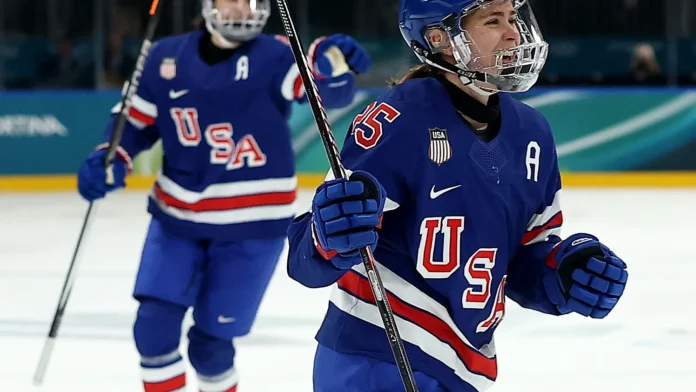
One of the most compelling local stories belongs to Alex Carpenter, a Morristown native and a cornerstone of Team USA’s roster. Competing in her third Olympic Games, Carpenter represents both national excellence and the deep developmental roots of hockey in New Jersey. Her journey—from youth programs in the state to international stardom—has become a blueprint for what sustained investment in women’s hockey can produce.
The Sirens themselves are heavily represented in Milan, with six players skating across multiple national teams. Among them are Canadian forward Sarah Fillier and Switzerland’s Nicole Vallario, reinforcing the idea that Newark is no longer simply a regional home for professional women’s hockey, but a meaningful contributor to the international talent pool.
Perhaps the most symbolic moment for New Jersey’s future arrived just ahead of the Games, when forward Elle Hartje was named the first-ever female ambassador for Hockey in New Jersey. The role centers on expanding access to the sport, especially for girls and underserved communities, and reflects a broader cultural shift that places growth and inclusivity alongside competitive success.
This growing connection between elite competition and grassroots development is reshaping how the state views its hockey identity. What once revolved almost exclusively around the Devils now spans youth programs, women’s professional hockey, international competition, and long-term community engagement.
That broader perspective is increasingly reflected in statewide coverage of the sport, particularly through Explore New Jersey’s ongoing reporting on the evolving hockey landscape, player development, and regional impact found throughout its hockey coverage.
For the Devils, the break represents both a physical pause and a psychological checkpoint. The organization enters this window knowing that the remaining schedule leaves little room for extended slumps. While players carry their responsibilities into Olympic competition, the coaching staff and front office will use the downtime to evaluate lineup balance, special teams performance, and the consistency of defensive structure that has wavered during recent losses.
The hope internally is that the Olympic stage provides more than visibility—it delivers momentum. For younger players such as Nemec, the experience of high-pressure international games can accelerate development in ways that regular-season NHL minutes simply cannot replicate. For veterans like Palát and Markström, leadership responsibilities in national jerseys may help reinforce habits the Devils desperately need when league play resumes.
Philadelphia faces a similar crossroads. With their postseason position already compromised, the Flyers must determine whether the stretch run becomes a late push for relevance or a transition period that prioritizes long-term roster clarity. Tocchet’s exposure to international coaching environments and systems during the tournament may also influence tactical decisions when the NHL calendar restarts.
The Olympic Games, however, are not merely a temporary diversion from difficult standings.
They serve as a reminder of how deeply New Jersey is embedded in the global hockey ecosystem. From star forwards and veteran goaltenders to emerging defensemen and rising women’s professionals, the state’s influence stretches far beyond its borders.
When NHL play resumes, the Devils and Flyers will return to a schedule defined by urgency. But for the moment, the focus shifts to Milan, where New Jersey’s players carry more than national colors. They carry the reputation of a region that continues to shape the future of the sport—on the ice, in the community, and on the world’s biggest hockey stage.
















