
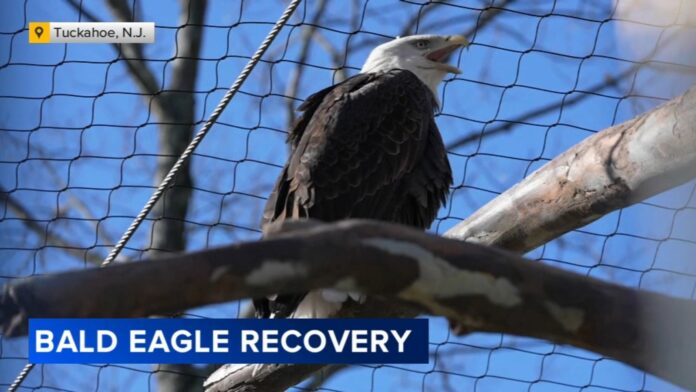

For the first time in more than four decades, New Jersey is officially celebrating one of the most remarkable wildlife recoveries in state history — the return of the bald eagle as a thriving, statewide breeding species and a powerful symbol of environmental resilience.
In January 2025, state wildlife officials formally removed the bald eagle from New Jersey’s endangered species list, marking a turning point that conservationists, birders, and environmental educators had worked toward for generations. The decision followed an extraordinary population rebound, growing from a single nesting pair in the early 1980s to a record-setting 293 active nesting pairs documented across the state in 2024.
The eagle’s recovery represents far more than a statistical milestone. It reflects decades of coordinated habitat protection, water quality improvements, public education, nest monitoring, and community-driven stewardship that transformed once-fragile river corridors and coastal marshes into functioning wildlife strongholds.
While the bald eagle is no longer designated as endangered, it has been reclassified as a species of special concern — a status designed to ensure that monitoring, habitat safeguards, and public awareness remain firmly in place. Conservation leaders emphasize that the comeback, while extraordinary, still depends on continued vigilance in the face of development pressure, climate impacts, and human disturbance.
That message was front and center across New Jersey this winter as communities came together to celebrate the eagle’s recovery — and to reinforce the responsibility that comes with success.
Just this past weekend, Cumberland County hosted one of the state’s most significant public conservation events of the season with the Cumberland County Winter Eagle Festival, drawing residents and visitors to Mauricetown for a day focused entirely on eagle ecology, field observation, and environmental education.
Based at the Mauricetown Firehall, the festival anchored a full slate of outdoor and educational programming. Participants joined guided nature walks through Glades Wildlife Refuge, where naturalists highlighted nesting habitat, shoreline food sources, and the subtle landscape features that make the Delaware Bay region so productive for raptors. Along the Delaware River, five staffed viewing stations were positioned at strategic overlooks, each equipped with high-powered spotting scopes and volunteers trained to help visitors identify eagles in flight, perched adults, and active nest sites across the river corridor.
One of the most popular features of the day was a series of live raptor presentations delivered by the Woodford Cedar Run Wildlife Refuge, where audiences had an opportunity to learn about bald eagle behavior, injury rehabilitation, and the increasingly complex challenges wildlife centers face as human and wildlife activity overlap more frequently.
For families, the festival offered an accessible way to experience conservation firsthand — not in a classroom or exhibit hall, but within the very landscapes that helped make the species’ recovery possible.
The celebration followed another major winter observance in northern New Jersey. In mid-January, Bergen County once again marked its annual Save the Bald Eagle Day, organized by the Bergen County Audubon Society. The most recent event, observed on January 17, 2026, underscored just how far eagles have expanded beyond their historic strongholds along the southern Delaware Bay.
Volunteer monitors documented 85 bald eagles in Bergen County alone — a number that would have been unthinkable in New Jersey only a generation ago. Local educators and conservation advocates used the occasion to spotlight how urban-suburban landscapes, when managed thoughtfully, can still support top-tier wildlife species.
Together, the two celebrations reflected a statewide narrative: the bald eagle has returned not just to remote wetlands and protected preserves, but to riverbanks, reservoirs, agricultural lands, and mixed-use environments throughout the state.
February now stands out as one of the most compelling times of year to witness that recovery firsthand. It is peak nesting season in New Jersey, when adult pairs are actively incubating eggs, reinforcing nest structures, and performing dramatic courtship flights over rivers and forested shorelines.
The epicenter of eagle activity remains the Delaware Bay region, where Cumberland and Salem counties collectively support nearly half of all known nests in the state. The wide tidal creeks, expansive marsh systems, and abundant fish populations along the bay continue to provide ideal conditions for breeding pairs. For wildlife observers, this region offers some of the most reliable viewing opportunities in New Jersey, particularly along quieter stretches of the river and bayfront where eagles are less likely to be disturbed.
In central New Jersey, Duke Farms in Hillsborough has emerged as one of the most recognizable public viewing locations for the species. The site’s long-running Eagle Cam has once again become a focal point of the 2026 nesting season, allowing residents across the state — and far beyond — to follow the daily rhythms of a breeding pair from home. Eagles at the site have been active since the fall, reinforcing nests and defending territory well ahead of the spring hatch window.
For many New Jersey families, the live camera has become an entry point into conservation awareness, connecting children to real-time wildlife behavior while reinforcing the importance of preserving open space, water quality, and undisturbed nesting habitat.
Those broader conservation connections are increasingly shaping how the state tells the bald eagle’s story. Wildlife managers now emphasize that the eagle’s success is inseparable from the protection of rivers, wetlands, forests, and public open space across New Jersey. From restored shorelines and reforested buffers to carefully managed recreation corridors, the landscapes supporting eagles also safeguard drinking water, flood resilience, and biodiversity statewide.
Residents interested in exploring the wider network of natural areas that support wildlife recovery can find inspiration through New Jersey’s extensive system of publicly accessible natural lands and conservation sites, including many of the destinations highlighted through Explore New Jersey’s coverage of parks and preserved open spaces.
That interconnected approach is especially critical as New Jersey enters a new phase of wildlife management. With more eagles occupying a wider range of habitats, conservation agencies are expanding nest monitoring programs, refining seasonal buffer zones around active nests, and increasing public outreach to prevent unintentional disturbances during sensitive breeding periods. Recreational boating, shoreline construction, drone use, and trail expansion all present modern challenges that require careful planning to ensure that the recovery does not stall.
Climate variability also adds uncertainty to long-term nesting success. Rising temperatures, shifting fish populations, and more frequent extreme weather events can directly affect both prey availability and nest stability along exposed shorelines. Conservation planners are now integrating climate adaptation strategies into habitat management plans, reinforcing shoreline vegetation, and prioritizing landscape connectivity to help wildlife populations adjust over time.
What makes the bald eagle’s return especially meaningful in New Jersey is how deeply it reflects the state’s environmental transformation. Once burdened by industrial pollution, degraded waterways, and unregulated land use, many of the same river systems that now support breeding eagles have undergone decades of restoration and regulatory reform. The eagle’s recovery has become a visible measure of that progress — one that residents can see overhead, perched along tidal creeks, or soaring above winter marshes.
As winter gives way to early spring, more hatchlings will soon emerge across the state, adding to a population that only forty years ago was on the brink of disappearing from New Jersey altogether. The gatherings in Mauricetown and Bergen County are not simply celebrations of a bird, but of a long-term commitment to stewardship that continues to reshape the state’s relationship with its natural environment.
The bald eagle may no longer be listed as endangered in New Jersey, but its presence remains a living reminder that conservation success is never a finished project. It is an ongoing partnership between science, community engagement, and the landscapes New Jersey continues to protect — one nesting pair at a time.
















