
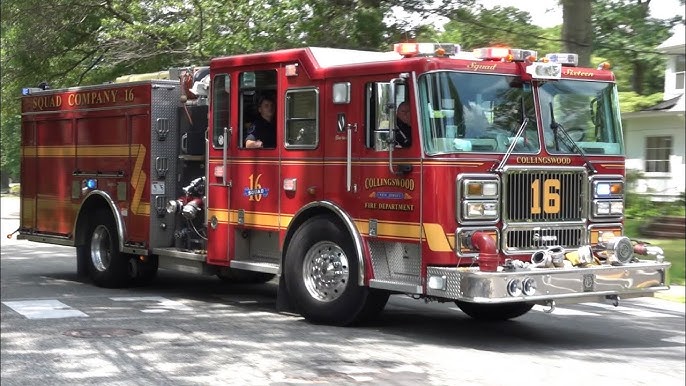

Even with mandatory overtime, borough fire and EMS teams are falling short on one in five emergencies, raising urgent public safety concerns across South Jersey
COLLINGSWOOD — A senior fire official in Collingswood is warning that the borough’s emergency response system is operating below acceptable staffing levels on a routine basis, leaving firefighters and emergency medical crews stretched thin during some of the community’s most critical moments.
Fire Captain Julian D’Alonzo said that despite aggressive scheduling and the widespread use of forced overtime, Collingswood first responders are still short-staffed on approximately 20 percent of fire and EMS calls.
“We’re not meeting the minimum standard,” D’Alonzo said, describing a daily operational reality in which units are dispatched without the recommended number of personnel to safely and efficiently handle emergencies ranging from medical calls to structure fires and traffic incidents.
The staffing shortfall, he said, is not the result of a single budget cycle or one failed hiring effort, but a long-building problem that has intensified as call volumes increase, training requirements expand and the pool of qualified candidates shrinks.
In a borough of just over 15,000 residents, Collingswood’s fire and emergency medical services respond to thousands of incidents each year. Those calls include not only local emergencies but also mutual aid requests from neighboring municipalities when surrounding towns experience their own staffing gaps or major incidents.
According to department leadership, the current staffing model often leaves crews operating below nationally recognized deployment benchmarks for both fire suppression and emergency medical response. That means fewer hands on scene to manage patient care, secure hazardous environments, deploy equipment, and ensure firefighter safety during active incidents.
In practical terms, the shortage can slow down critical tasks such as establishing water supply at fires, performing coordinated searches, or delivering advanced life support during medical emergencies. It can also force officers to make difficult decisions about how to allocate limited personnel in rapidly evolving situations.
D’Alonzo said the reliance on mandatory overtime has become routine rather than exceptional.
“Overtime was supposed to be a short-term bridge,” he said. “Now it’s built into how we operate.”
While overtime can temporarily fill empty seats on apparatus, it also carries hidden risks. Fatigue among first responders is a growing concern, particularly in departments where staffing levels require firefighters and medics to work back-to-back shifts or extended hours with minimal recovery time.
Fire service safety experts consistently point to exhaustion as a contributing factor in on-the-job injuries, slower reaction times and increased stress-related health issues.
At the municipal level, borough officials acknowledge that the problem is real and growing more complex. Collingswood’s governing body is preparing to retain a professional consultant within the next month to conduct a comprehensive staffing and deployment study of the fire and EMS operations.
The review is expected to examine call volume trends, staffing patterns, shift schedules, response times, overtime usage, training demands and long-term workforce planning.
Officials say the study is intended to provide an independent assessment of how many firefighters and EMS personnel the borough actually needs to meet modern public safety standards — not simply what the current budget can sustain.
But leaders also caution that solving the problem will not be easy.
Several overlapping pressures are shaping Collingswood’s staffing challenge. Recruitment has become more difficult across the region as fewer applicants pursue careers in fire and emergency medical services. Training pipelines are longer and more specialized than in the past, particularly for paramedic certification. At the same time, experienced personnel are retiring or leaving for higher-paying departments elsewhere in the state.
The competition for qualified firefighters and paramedics has intensified throughout South Jersey, where municipalities are increasingly forced to recruit from the same limited pool of candidates.
Compounding the issue is the rising complexity of emergency calls. Collingswood crews are responding to a higher proportion of medical incidents involving aging residents, opioid overdoses, mental health crises and multi-patient emergencies. These incidents require more personnel on scene and longer time commitments per call, tying up units and further straining staffing availability.
From a financial standpoint, overtime costs have climbed steadily as the borough relies on extra shifts to keep apparatus in service. While overtime is often less expensive in the short term than adding full-time positions, officials concede that it is not a sustainable long-term strategy.
Public safety advocates argue that the borough must weigh the true cost of understaffing — including injury risk, burnout, delayed responses and reduced operational capacity — against the price of expanding the workforce.
The situation unfolding in Collingswood mirrors a broader trend across New Jersey, where fire and EMS departments are increasingly struggling to maintain staffing levels that match modern emergency response demands. Municipal leaders across the state are facing difficult choices about public safety funding, recruitment incentives and regional cooperation strategies.
Coverage of staffing and emergency services challenges remains a growing focus for Sunset Daily News as communities across the state reassess how public safety systems are funded, staffed and supported.
For frontline responders in Collingswood, however, the issue is not abstract.
When staffing falls short, D’Alonzo said, the consequences are felt immediately on the street and inside homes during emergencies.
“When we show up without the right number of people, the job doesn’t get smaller,” he said. “The risk just gets bigger — for our residents and for our firefighters.”
As the borough prepares to commission its outside staffing review, both union leaders and department officers are urging officials to treat the findings as more than a procedural exercise. They say the study must translate into concrete hiring plans, competitive compensation strategies and long-term workforce investments if Collingswood hopes to stabilize its emergency services and meet accepted response standards.
Until then, crews will continue to rely on overtime and personal sacrifice to keep engines staffed and ambulances rolling — even as leaders inside the department warn that the margin for error is shrinking with every understaffed call.
















