
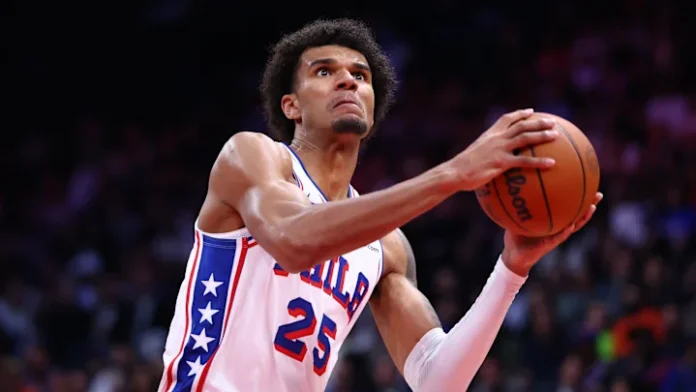

On a night that quietly reshaped the narrative around Philadelphia’s evolving rotation, Dominick Barlow delivered the most complete performance of his young NBA career and helped propel the 76ers to a convincing 128–113 win over the Los Angeles Clippers, extending the club’s surge to four straight victories and reinforcing a growing belief that this roster is finding unexpected answers in the middle of an unpredictable season.
For New Jersey and regional basketball fans tracking every development surrounding the Sixers, the performance stands out not only for its box-score impact, but for what it represents about Philadelphia’s depth, adaptability, and willingness to elevate overlooked contributors when circumstances demand it. Those storylines continue to be a major focus across Explore New Jersey’s ongoing coverage of the team within our Philadelphia 76ers section, where roster trends and player development are shaping the broader conversation around the franchise’s future.
Barlow, a former undrafted prospect who has steadily carved out a role through persistence and defensive reliability, exploded for 26 points and 16 rebounds, controlling the paint on both ends and repeatedly punishing Los Angeles on second-chance opportunities. His activity level set the tone early, but it was his poise around the basket and decisiveness in traffic that transformed a strong outing into a genuine breakout moment.
Philadelphia never trailed in the contest.
The Sixers came out sharp, aggressive, and fully committed to attacking mismatches inside, building an early rhythm that forced the Clippers into a reactive posture. By halftime, the home side had already opened a commanding 72–53 advantage, fueled by relentless transition pressure and crisp ball movement that consistently created clean perimeter looks.
Tyrese Maxey remained the engine.
The All-Star guard poured in 29 points, burying seven three-pointers and once again showcasing why he has become the emotional and tactical heartbeat of Philadelphia’s offense. Maxey’s ability to stretch the floor opened wide driving lanes for Barlow and Joel Embiid, creating a three-pronged attack that Los Angeles struggled to contain throughout the night.
While Maxey’s perimeter shooting provided the highlight moments, the story underneath the scoring was Philadelphia’s control of tempo and physicality. Barlow’s rebounding dominance repeatedly short-circuited Clippers possessions and allowed the Sixers to dictate the pace of play, a critical factor against a veteran opponent built around half-court execution.
Joel Embiid, continuing to work his way back into full rhythm following a right ankle injury, added 24 points in a steady, controlled performance that reflected a star still calibrating timing and explosiveness. The numbers were solid. The comfort level is clearly still trending upward. Yet even in a game where Embiid was not asked to carry the entire offensive burden, his presence continued to warp defensive coverage and create spacing advantages for teammates.
One of the more intriguing subplots of the night centered on two marquee names who were notably absent from the NBA’s All-Star reserve selections: Embiid and Clippers forward Kawhi Leonard. Both players used the game as a quiet reminder of their continued elite impact.
Leonard led Los Angeles with 29 points and delivered several late highlights, including two powerful dunks and a three-pointer during a brief fourth-quarter push. However, the Clippers were never able to string together the sustained defensive stops required to make the game truly competitive in the final period, and Leonard eventually watched the closing minutes from the bench.
Jordan Miller provided a lift off the bench for Los Angeles, contributing 21 points and injecting energy during stretches when the Clippers needed momentum. But even his production could not compensate for the absence of James Harden, who missed his second consecutive game due to personal reasons. Clippers head coach Tyronn Lue confirmed prior to tip-off that Harden remained at home in Phoenix, leaving the team short on playmaking and offensive orchestration.
That void became increasingly apparent as the game wore on.
Philadelphia’s defensive rotations were sharp, perimeter close-outs were timely, and the Sixers repeatedly forced Los Angeles into late-clock situations that stalled potential runs before they could develop. Even when the Clippers briefly trimmed the margin, the response from Philadelphia was immediate and organized.
The pivotal stretch came in the third quarter.
Although the Clippers narrowly outscored the Sixers 34–28 in the period, Philadelphia still emerged with a 100–87 lead, a testament to the cushion built earlier and the composure of the offense. Maxey, Barlow, and Embiid combined for 22 points during the quarter, answering each Los Angeles push with baskets that stabilized the flow of the game.
For a Sixers roster navigating unusual circumstances this season, including the continued absence of Paul George due to a 25-game suspension for violating the league’s anti-drug program, the ability to generate consistent production from unexpected sources has become a defining characteristic of their recent success. With George sidelined, Philadelphia improved to 11–10 in games played without him, a mark that underscores both the challenge and resilience facing the club.
Barlow’s emergence could not have come at a more important moment.
Beyond the raw totals, his defensive positioning, willingness to contest without fouling, and effort on box-outs provided the structural backbone for Philadelphia’s interior defense. Against a Clippers lineup designed to exploit switches and drive-and-kick opportunities, Barlow consistently closed space and recovered quickly enough to disrupt second actions.
Just as critical was his offensive patience.
Rather than forcing shots, Barlow operated within the flow of the offense, capitalizing on dump-offs, offensive rebounds, and quick finishes generated by Maxey’s penetration and Embiid’s gravitational pull in the post. It was a performance built on timing, discipline, and trust in the system—exactly the traits coaches value when determining whether a breakout night can translate into a sustainable role.
Los Angeles entered the contest playing strong basketball, winning eight of its previous 11 games while attempting to remain firmly within reach of the Western Conference play-in picture. Yet the matchup exposed how thin the margin becomes when one or two critical pieces are unavailable, particularly for a team heavily dependent on half-court creation.
For Philadelphia, the win was about more than extending a streak.
It reinforced an identity that has quietly taken shape over the past several weeks—an identity built around speed on the perimeter, collective rebounding, and opportunistic scoring from players willing to seize expanded responsibilities. The Sixers have not simply survived lineup disruptions. In several key moments, they have evolved because of them.
That evolution is especially visible in the way Maxey has embraced his leadership role. His shot selection has grown more selective, his reads out of double teams have sharpened, and his willingness to trust emerging teammates such as Barlow speaks to a locker room dynamic that continues to mature under pressure.
The schedule offers little time to celebrate.
Philadelphia closes a demanding back-to-back on the road against the Golden State Warriors, a test that will quickly reveal whether the momentum generated by this performance can carry over against a different style of opponent and a more mobile defensive structure.
Still, nights like this resonate beyond a single box score.
Dominick Barlow’s career performance stands as a reminder that NBA seasons are often shaped by unexpected contributors rising when opportunity appears. For the Sixers, searching for stability and continuity during a turbulent stretch of the calendar, his emergence may prove to be one of the most meaningful developments of their midseason push.
















