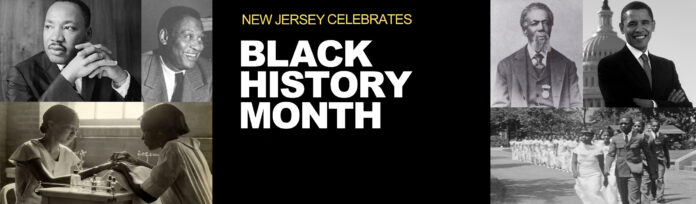

In New Jersey this February, Black History Month is being launched not as a look backward, but as a declaration of momentum — a statewide affirmation that history is not something finished, sealed, or safely archived. It is something still being written.
Today, February 2, 2026, officially marks the 100th anniversary of the first national Black History celebration. New Jersey has a robust schedule of festivals, historical recreations, and community expos throughout the month.
Major Festivals & Community Expos
- Black History Month 2026 Expo (Union Township): A massive free community event on Feb. 7 from 1:00 PM – 6:00 PM at the Jefferson School Auditorium. It features an art gallery, live music, and over 40 Black-owned business vendors.
- 7th Annual African American Read-In (Piscataway): Scheduled for Feb. 21 at 11:00 AM at the John F. Kennedy Library, this event celebrates Black authors and cultural contributions through literature and crafts.
- Rays of Hope: Living Black Museum (Princeton): On Feb. 23 at 3:00 PM, the Arts Council of Princeton will host a “living museum” celebrating Black culture through interactive exhibits by local youth.
Historical Recreations & Performance
- Madame Selika: 1878 Songbird in the White House (Elizabeth): A free theatrical recreation on Feb. 19 at the Union County Courthouse (or adjacent venue) commemorating the first free person of color to perform at the White House.
- Hannah Till: Black History in the Revolutionary War (South Orange): Historical interpretation sessions throughout February at The Woodland Parlor, focusing on the life of General Washington’s enslaved cook.
- Cirque Kalabante: Afrique en Cirque (Morristown): A high-energy performance showcasing African culture and acrobatics at the Mayo Performing Arts Center on Feb. 13 at 8:00 PM.
Art Exhibitions & Museum Events
- Honor the Past, Inspire the Future (Margate): This exhibition opens today, Feb. 2, at the Katz JCC and runs through March 1, featuring regional artists like E.B. Lewis and Kimberly Camp.
- Allan Rohan Crite: Neighborhood (New Brunswick): A major exhibition opening this month at the Zimmerli Art Museum at Rutgers, with a celebratory “SparkNight” event on Feb. 12 featuring live music and art activities.
- Seeing America Exhibit (Newark): Throughout February, the Newark Museum of Art features galleries dedicated to the Harlem Renaissance and the Civil Rights Movement.
Lectures, Tours & Book Signings
- Four Centuries of African American Soldiers (Trenton): A living history program on Feb. 21 at the William Trent House documenting the stories of Black warriors throughout American history.
- Douglass Day (Skillman): The Stoutsburg Sourland African American Museum will host a special event on Feb. 13 featuring records from the historic Colored Conventions movement.
- A Raisin in the Sun (Maplewood): A local production of the Lorraine Hansberry classic begins on Feb. 13 as part of the township’s month-long celebration.
- A’Lelia Bundles Author Talk (Montclair): On Feb. 21, the Montclair Public Library hosts A’Lelia Bundles to discuss her new biography on Harlem Renaissance icon A’Lelia Walker.
Overnight & Immediate Events (Feb 2 – Feb 3)
- Union County Flag Raising: Today at 1:00 PM at the Union County Courthouse Rotunda in Elizabeth.
- Crafternoon: Traffic Light Craft: Today at 4:00 PM at the Mercer County Library (Hopewell Branch), honoring inventor Garrett Morgan.
- Underground Railroad Virtual Lecture: On Feb. 3 at 6:00 PM, the Mercer County Library is hosting a virtual program on abolition in South Jersey.
Across Union County, Atlantic County, Essex County, and Mercer County, today’s kickoff events form a coordinated cultural pulse that stretches from courthouse rotundas to university walkways, neighborhood galleries, and children’s craft tables. Together, they echo the same central idea now gaining traction in Black scholarship and storytelling: freedom is not the end of the story. It is where the real work begins.
That message is also being amplified through a new historical novella marking the centennial of Black History Month, a literary project that deliberately resists familiar narratives of closure and triumph. Instead of framing liberation as a final destination, the story positions it as a fragile, complicated, and often unfinished beginning. Its characters are not only inheritors of struggle, but architects of what comes next — a reframing that resonates powerfully with what is unfolding today throughout New Jersey.
In Union County, the official opening of the county’s Black History Month observance takes place this afternoon inside the courthouse rotunda, where a ceremonial flag raising signals far more than a calendar milestone. The setting itself is symbolic. A space traditionally associated with law, authority, and civic power becomes a platform for acknowledging how Black history has shaped — and continues to shape — public life, local governance, and collective responsibility. The ceremony draws county leaders, community advocates, students, and residents into a shared moment of recognition that extends beyond celebration into civic affirmation: Black history belongs at the center of New Jersey’s public institutions.
That sense of presence and visibility carries south to Margate, where the Katz JCC opens a new exhibition titled Honor the Past, Inspire the Future. The gallery brings together prominent Black artists from Atlantic City and the surrounding region in a show designed to highlight both creative excellence and generational continuity. Paintings, mixed media works, and contemporary visual storytelling occupy the same cultural space, offering visitors an immersive portrait of how Black artists interpret legacy in real time.
The exhibition is especially notable for how it situates regional voices within a broader artistic narrative. Rather than importing national figures to define cultural value, the show centers local creators whose work is shaped by the lived realities of South Jersey’s coastal communities, urban corridors, and evolving neighborhoods. The result is not simply an art display, but a regional cultural statement — one that positions Atlantic County as an active contributor to the state’s creative future. For readers seeking a deeper look at how visual arts and cultural programming continue to shape communities statewide, Explore New Jersey’s ongoing coverage of New Jersey’s art and culture scene provides a broader context for how exhibitions like this fit into a much larger creative ecosystem.
In Newark, the opening of Rutgers–Newark’s month-long initiative, RU-N with Legacy: Celebrating 100+ Years of Black Excellence, extends the conversation into higher education and public scholarship. The launch event on the PRCC Student Street transforms the campus into an open community gathering space, inviting students, faculty, alumni, and city residents to participate in a shared exploration of Black achievement across disciplines.
The program is designed as a living archive — not a static lecture series, but a multi-week sequence of conversations, performances, workshops, and historical reflections that trace Black excellence through education, science, public service, literature, activism, and the arts. By situating the kickoff outdoors and in the heart of campus foot traffic, the university reinforces its message that Black history is not confined to academic departments or special observances. It is embedded in everyday institutional life and intellectual leadership.
What makes this year’s Rutgers–Newark observance especially significant is its framing. The theme deliberately extends beyond commemoration, emphasizing continuity and responsibility. Students are encouraged to examine how past achievements inform present challenges — from access and equity in education to representation in research and public leadership. The programming underscores that the legacy being celebrated is not something to admire from a distance, but something to steward.
That emphasis on stewardship becomes most tangible in Mercer County, where the Hopewell Branch of the Mercer County Library System hosts a hands-on “Crafternoon” designed for children. Young participants will create traffic light–themed crafts inspired by the work of Garrett Morgan, the inventor whose innovations improved traffic safety and emergency response.
For many families, this program will be a child’s first introduction to the idea that inventors, engineers, and problem-solvers come from every background — and that Black innovation has shaped everyday life in ways most people never pause to consider. By translating history into creative activity, the library is doing something quietly powerful: it is teaching young residents that Black history is not distant, abstract, or reserved for textbooks. It is visible in the infrastructure that organizes their streets, protects their communities, and supports modern life.
This child-centered approach mirrors the philosophy behind the new historical novella being released to mark the 100-year legacy of Black History Month. Rather than recounting familiar moments of emancipation or landmark court victories as narrative endpoints, the story follows families and community leaders navigating what freedom actually requires once legal barriers fall. Education gaps, economic uncertainty, cultural preservation, and political participation become central plotlines — emphasizing that liberation is not a single event, but an ongoing practice.
The novella’s relevance to today’s New Jersey observances is striking. From courthouse ceremonies to gallery walls, university streets to library craft tables, the same themes surface again and again: agency, creativity, and responsibility. Each event, in its own way, reinforces the idea that history gains meaning only when it actively informs how communities organize, teach, and imagine their future.
What distinguishes this year’s Black History Month kickoff across New Jersey is its regional breadth paired with a unified cultural message. Union County foregrounds civic belonging. Atlantic County elevates creative leadership. Essex County invests in scholarly and community dialogue. Mercer County plants the seeds of innovation and representation with its youngest residents. Together, these programs form a statewide narrative arc that mirrors the evolving national conversation about how Black history is taught, shared, and lived.
Just as importantly, these initiatives challenge the notion that Black history programming must be limited to lectures and memorials. In New Jersey, it is unfolding as ceremony, exhibition, storytelling, public scholarship, and creative play — multiple entry points designed to engage residents of all ages and backgrounds.
At a time when public discourse around history, identity, and representation remains deeply polarized, New Jersey’s Black History Month launch offers a different model. It replaces defensiveness with openness, and replaces nostalgia with forward motion. The events unfolding today are not positioned as symbolic gestures, but as living platforms — spaces where community members can see themselves reflected, recognized, and invited into the work of shaping what comes next.
In that sense, the new novella’s central premise resonates far beyond its pages. Freedom, as New Jersey’s communities are demonstrating this month, is not a commemorative finish line. It is an open door — and the responsibility to decide, together, how boldly to step through it.