
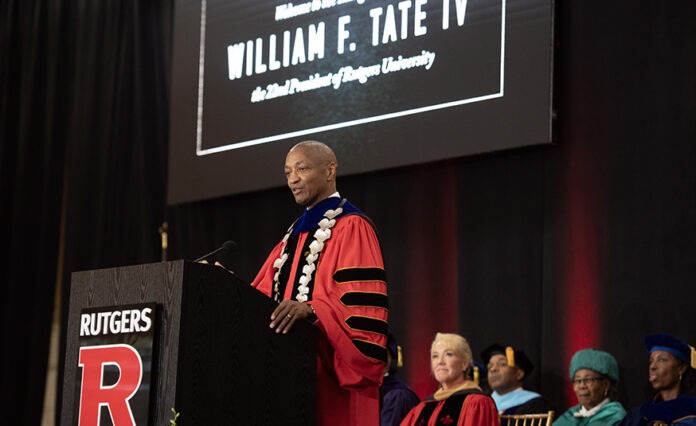

When William F. Tate IV stepped into office this summer as Rutgers University’s 22nd president, he arrived with a clear sense of purpose and an equally clear understanding of what the state expects from its flagship public institution. A nationally respected social scientist and former president of Louisiana State University, Tate brings to New Jersey a career shaped by research, public service, and an unwavering belief in the power of education to transform lives at scale.
Now leading one of the nation’s largest and most complex public university systems, Tate is positioning Rutgers for a period of strategic growth centered on social mobility, research excellence, and deeper partnerships across New Jersey’s health, business, and public sectors. His appointment comes at a pivotal moment for the university, as higher education faces shifting federal funding priorities, changing student demographics, and increasing pressure to demonstrate measurable public impact.
Raised in Chicago’s historic Bronzeville neighborhood on the city’s South Side, Tate credits his upbringing with shaping both his intellectual curiosity and his commitment to public education. He often points to a family culture rooted in learning, debate, and service. His paternal grandmother, an educator, encouraged exploration well beyond the classroom, guiding him toward informal learning environments such as science museums and cultural institutions. His mother worked in an academic medical center and regularly brought home professional journals, introducing him early to the language of medicine, research, and evidence-based inquiry. His father, who worked in the scientific supply industry before entering the nonprofit sector, nurtured a love of science and argument, filling the home with microscopes, telescopes, and spirited discussions.
Those early experiences were reinforced through a Catholic school education that emphasized discipline, civic responsibility, and the value of contributing to the greater good. Combined with the vibrant exchange of ideas among classmates and friends, Tate developed a lifelong appreciation for reasoned debate, storytelling grounded in evidence, and the pursuit of ideas that move communities forward.
That philosophy aligns closely with what first drew him to Rutgers. During the national search process, Tate says he was struck by the breadth and depth of the university’s faculty and academic programs, as well as by the institution’s unique position within a densely populated, economically diverse state. Rutgers, in his view, stands on the edge of a defining opportunity—one that allows it to expand access, elevate academic excellence, and deliver tangible benefits to residents across every region of New Jersey.
The challenges ahead, however, are substantial. New Jersey’s demand for higher education excellence is uncompromising, particularly when it comes to affordability and workforce preparation. Tate has made it clear that Rutgers must continue to serve as a primary engine of social mobility, ensuring that students from all backgrounds and zip codes can access a world-class education without being priced out of opportunity.
A cornerstone of his strategy centers on strengthening Rutgers’ academic competitiveness while preserving its broad public mission. That includes expanding honors education, enhancing the business school, and maintaining strong investment in the humanities, social sciences, and professional programs. Equally important, he emphasizes the recruitment and retention of exceptional faculty and staff who can sustain the university’s teaching and research excellence well into the future.
Health and biomedical research represent another major pillar of Tate’s vision. Through its partnership with RWJBarnabas Health, Rutgers continues to build a national model for evidence-based cancer care and advanced research in cancer, brain health, and cardiovascular science. Tate sees this collaboration as a defining opportunity to elevate the university’s national standing while directly improving health outcomes for New Jersey residents.
At the same time, the university must navigate ongoing uncertainty tied to federal funding levels and global enrollment shifts. Tate has emphasized that flexibility in the university’s funding model is essential. Rutgers, he says, must be prepared to adapt to changing public investment patterns without shifting the burden onto students. Protecting affordability remains a non-negotiable priority.
Despite concerns facing higher education nationally, Rutgers has seen encouraging enrollment trends. International enrollment, often vulnerable to global and policy changes, has rebounded, with fall enrollment exceeding the previous year by more than six percent. For Tate, this signals both the global appeal of Rutgers and the importance of sustaining an inclusive, internationally engaged campus environment.
Longer-term, Tate has outlined an ambitious set of institutional benchmarks. He believes Rutgers can significantly improve its national profile across its campuses, with aspirations to move New Brunswick into the top ten among public universities, Newark into the top thirty, and Camden into the top forty. These goals are driven by a comprehensive focus on reducing attrition, improving graduation rates, and strengthening the university’s already strong record of social mobility.
Research growth will be a central driver of that progress. During his tenure at LSU, Tate oversaw notable increases in funded research activity, and he intends to pursue similar momentum at Rutgers. The university already secures close to one billion dollars annually in research funding, and despite recent federal policy shifts, research expenditures continued to rise in fiscal year 2025. Tate sees Rutgers’ research mission as deeply intertwined with the real needs of New Jersey, spanning food security, environmental and coastal resilience, cancer prevention and treatment, biomedical innovation, drug discovery, engineering, education, and social policy.
In Tate’s view, the true measure of research excellence is not only academic prestige, but public relevance. The people of New Jersey, he often notes, are visible in the very questions Rutgers researchers are working to answer.
Looking ahead, students and faculty can expect a sharper focus on external partnerships designed to move ideas from laboratories and classrooms into communities and industries. Tate has called for more aggressive collaboration with New Jersey’s business leaders, government agencies, and health care systems to accelerate innovation and create applied opportunities for students and scholars alike.
One of the most visible new student-focused initiatives under his leadership is the launch of the Edge Fund, a scholarship program designed to recognize and support students whose talents and contributions elevate the university in ways that may fall outside traditional academic metrics. Artists, coders, writers, innovators, and competitors in non-revenue sports will be eligible for support, reflecting a broader definition of excellence and impact across campus life.
As Rutgers enters this new chapter, Tate’s presidency arrives at a moment when the university’s academic, research, and athletic identities are increasingly intertwined in shaping its public profile. Readers following the evolving story of the Scarlet Knights and campus life can explore ongoing coverage through Explore New Jersey’s Rutgers Scarlet Knights section, which highlights how leadership, competition, and community continue to shape the university’s statewide presence.
For Tate, however, rankings, funding totals, and national visibility remain secondary to a deeper objective: creating sustainable cycles of opportunity. His vision centers on graduates who leave Rutgers equipped to serve their communities, build careers in New Jersey and beyond, and contribute innovations that improve daily life across the state.
In an era defined by rapid social, technological, and economic change, William Tate is positioning Rutgers not simply to keep pace, but to lead—anchored in access, driven by research, and focused squarely on the future of New Jersey.
















