

The Philadelphia Flyers are running out of time to stabilize a season that has suddenly shifted from competitive to fragile, as a prolonged losing streak continues to expose systemic issues throughout the lineup.
Philadelphia has now dropped 10 of its last 12 games and enters the weekend having lost three straight, a stretch that has pushed the club out of a once-secure playoff position and into a tightening, unforgiving race. What had looked like a resilient, defensively responsible group earlier in the year now appears disjointed, reactive, and increasingly vulnerable in all three zones.
The most recent setback—a 6–3 loss to Boston on Thursday night—captured nearly every problem plaguing the Flyers during this downturn.
Complicating the night from the outset, the team’s travel from Columbus was disrupted, and the club did not arrive in Boston until after 4 a.m. While fatigue was unavoidable, the performance that followed suggested a deeper erosion of structure and confidence. By the end of two periods, Philadelphia was already buried, struggling to track assignments and contain sustained pressure in its own end.
The result extended a troubling pattern. The Flyers are now 2-8-1 in their last 11 games overall and continue to fall behind early at an alarming rate. Too often, the group has been forced to chase games rather than dictate pace, placing immediate stress on both the defense corps and the goaltending rotation.
Internally, the frustration is no longer hidden.
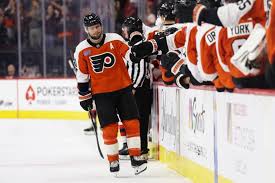
Alternate captain Travis Konecny has openly acknowledged how difficult it has been to watch the team slide out of the playoff picture. Ironically, his own performance has been one of the few constants during the collapse. In January alone, Konecny recorded 13 points in 11 games, including eight goals, repeatedly providing offensive sparks in games where scoring support has been scarce.
That was again the case in Boston, where Konecny finished one of Philadelphia’s rare sustained shifts in the offensive zone to briefly pull the Flyers back within reach. But as has become common throughout this slump, those moments were fleeting rather than foundational.
The larger problem has been cohesion.
Captain Sean Couturier, who was dropped to the fourth line and logged just over 13 minutes of ice time against the Bruins, described a group that is struggling to stay connected through all three zones. The Flyers’ early-season identity—built on layered defensive support, clean exits, and disciplined puck management—has steadily unraveled.
Against Boston, breakdowns were frequent and costly. Defensive switches were missed. Forwards failed to collapse low enough to support coverage in the slot. Neutral-zone structure was loose, allowing controlled entries and extended zone time against. The Flyers were often chasing the play instead of shaping it.
Head coach Rick Tocchet was blunt in his postgame assessment. Effort, he said, was present. Execution was not. Too many mental lapses turned manageable sequences into goals against.
The instability in net has only amplified those mistakes.
Sam Ersson, who has carried much of the workload this season, endured another difficult night. While he faced consistent pressure, several goals were the product of clean looks and delayed reactions. Late in the second period, Ersson left the game with what was officially listed as a lower-body injury after appearing uncomfortable following a sequence in the crease.
Dan Vladar was forced into action in relief—just one night after returning from injured reserve.
The Flyers’ goaltending situation has become one of the most volatile variables in their season. Injuries to both Ersson and Vladar have prevented any rhythm from developing, and defensive confidence in front of the crease has clearly suffered. Coverage has tightened inward, lanes have opened on the back side, and rebounds have turned into prolonged scramble situations.
The loss to Boston followed a now familiar script.
Philadelphia conceded two goals in quick succession in the opening period, both stemming from lost coverage and delayed reactions. A potential momentum swing was erased when a Flyers goal was overturned following a coach’s challenge for goaltender interference, further draining energy from a bench already searching for traction.
The second period proved decisive. A soft goal early widened the margin, and although the Flyers answered briefly, Boston reasserted control through heavy zone time and traffic-driven scoring chances. A tipped long shot and a late-period scramble goal pushed the game out of reach before the intermission.
Even a late power-play marker could not disguise the broader concerns.
Special teams, once a stabilizing component of Philadelphia’s game, have become a liability. The power play now sits at the bottom of the league, struggling to establish entries, generate interior movement, or create layered shooting threats. The penalty kill, which had helped anchor the Flyers through stretches of uneven five-on-five play earlier in the season, has also slipped, allowing opponents too much time to manipulate coverage and draw defenders out of structure.
Injuries have further exposed the club’s thin margins.
Defenseman Rasmus Ristolainen recently exited a game after only two shifts with a lower-body issue and, while he returned to the lineup in Boston, the blue line remains under strain. Up front, injuries to key depth forwards have narrowed the Flyers’ offensive options, forcing heavier minutes onto a small core of producers.
When that core is neutralized, Philadelphia has struggled to generate sustained offensive-zone pressure. Scoring has come in isolated bursts rather than in layered, repeatable shifts that wear down opposing defenses.
Analytically and visually, the warning signs are consistent. The Flyers are surrendering too many high-danger chances from the slot and the weak side. Defensive spacing has widened. Zone exits are rushed and frequently turn into immediate re-entries against. Forecheck timing is inconsistent, allowing opposing defensemen to reset under minimal pressure.
Perhaps most concerning is the team’s inability to manage late-game situations. When trailing by one or two goals, Philadelphia has often abandoned structure in favor of high-risk plays through the middle of the ice, leading to turnovers and rapid counterattacks. The lack of composure in those moments has erased opportunities to mount controlled comebacks.
The approaching trade deadline only adds complexity to an already unsettled situation.
Despite the slide, there are currently no Flyers prominently listed on major trade boards, but league chatter continues to link the organization to potential high-end talent. Whether management views this season as a foundation to build upon—or a warning that adjustments are necessary—will likely be shaped by what happens in the next handful of games.
The Flyers return home Saturday afternoon to face the Los Angeles Kings, a matchup that has quickly taken on outsized importance. With only three home games remaining before the Olympic break, the opportunity to reset the season is shrinking fast.
What was once a team defined by discipline, defensive reliability, and competitive consistency is now searching for identity. The causes of the current freefall are no longer subtle: slipping defensive structure, unstable goaltending due to injury, ineffective special teams, and a growing disconnect between lines.
Unless those elements come back into alignment quickly, Philadelphia’s early-season promise will continue to fade—and the gap between where this team expected to be and where it now stands will only widen as the schedule turns toward the stretch run.
















