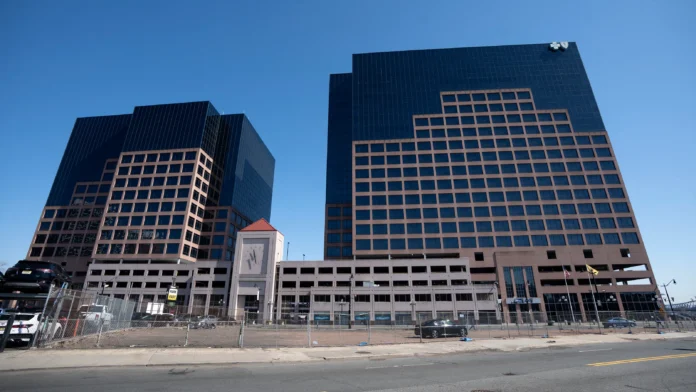

NJ Transit and Horizon Blue Cross Blue Shield of New Jersey have unveiled a bold redevelopment initiative in Newark that promises to reshape the city’s downtown with a combination of residential, commercial, and office space. The plan calls for the construction of 1,000 new apartments alongside a 250,000-square-foot Class A office tower that will serve as Horizon’s new headquarters. Situated on a three-acre site with sweeping views of the Passaic River and the Manhattan skyline, the project is positioned to become a cornerstone of Newark’s ongoing urban revitalization.
The initiative is part of NJ Transit’s broader LAND Plan, a strategic vision designed to generate non-fare revenue while leveraging the agency’s real estate assets to stimulate local economies. The LAND Plan is projected to bring in up to $1.9 billion over the next three decades, and redeveloping its former headquarters in Newark is considered a pivotal step in this long-term strategy. NJ Transit CEO Kris Kolluri emphasized that the plan balances financial prudence with community impact, creating jobs, new housing, and opportunities for long-term investment in urban centers.
Horizon’s decision to relocate to a modernized office tower reflects a growing trend among corporations to optimize their physical footprint while investing in state-of-the-art facilities that enhance collaboration and efficiency. The new headquarters will provide a contemporary, flexible workspace that meets the evolving needs of the company’s employees and clients, all while remaining rooted in the city where Horizon has operated for nearly a century.
To move the project forward, JLL and CBRE are working together to solicit developer interest, offering an Information Sharing Event for potential partners. Interested parties can register by December 31, 2025, to access a Confidential Information Memorandum outlining project details, potential financial models, and bid evaluation criteria. Developers who attend the session will gain insights into the anticipated timeline, project scope, and the collaborative approach designed to keep both NJ Transit and Horizon engaged in Newark while advancing the redevelopment effort.
Newark Mayor Ras Baraka has praised the proposal as a “future-facing redevelopment” that will become a centerpiece of the city’s growth. By combining residential units with high-quality office space and enhanced riverfront access, the project is expected to attract new residents, energize local businesses, and reinforce Newark’s position as a hub of economic activity in the tri-state region. Baraka highlighted the strong partnership between corporate anchors and city leadership as key to the project’s potential success.
The redevelopment is also expected to tap into state incentives such as the Aspire NJ program, which supports large-scale mixed-use projects that contribute to long-term urban revitalization. Programs like Aspire NJ have recently backed major projects in Jersey City, New Brunswick, and Secaucus, demonstrating the state’s commitment to fostering transformative development initiatives. Both NJ Transit and Horizon aim to leverage these resources to ensure the project achieves maximum economic and community impact.
CBRE Executive Vice President Gil Medina emphasized that keeping both organizations in Newark while advancing redevelopment goals demonstrates a coordinated approach to urban planning and corporate investment. JLL Executive Vice President Ron Simoncini noted that the project evolved through extensive collaboration and is now poised to take advantage of the city’s strong infrastructure, strategic location, and access to public transportation, including proximity to Newark Penn Station and the Ironbound district.
The proposed redevelopment represents a significant step forward in Newark’s urban transformation, combining modern residential living with premium office space, public access to waterfront amenities, and long-term economic growth. It underscores New Jersey’s commitment to innovative, collaborative urban development strategies that benefit residents, businesses, and the broader community.