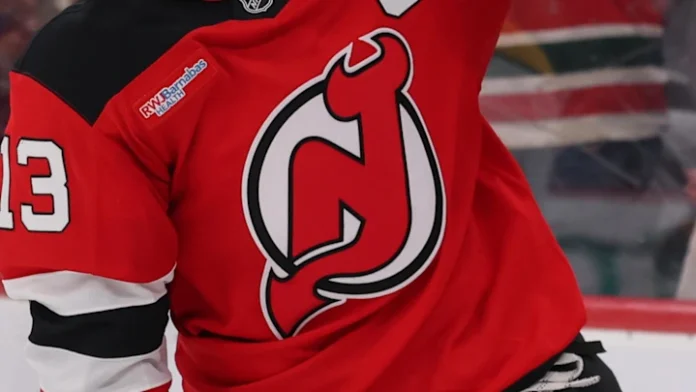

The New Jersey Devils find themselves at a defining crossroads as the 2025–26 NHL season enters its final stretch, a moment where the urgency of the present collides directly with the long-term vision of the franchise. Sitting seventh in the Metropolitan Division with a 37-33-2 record as of March 29, the Devils remain technically alive in the playoff race—but only in the most mathematical sense. With postseason odds reduced to a fraction of a percent, the conversation has shifted from chasing a near-impossible berth to evaluating what this stretch run reveals about the roster, the system, and the organization’s trajectory heading into next season.
For those following the evolution of the franchise and its long-term outlook, the New Jersey Devils coverage continues to track every development, from roster construction to organizational strategy, as the team navigates this critical inflection point.
The latest setback came in a 5-2 loss to the Carolina Hurricanes, a game that encapsulated both the promise and the frustration that have defined this Devils season. New Jersey opened with purpose, taking a 1-0 lead into the first intermission and showing the kind of structured, fast-paced hockey that had fueled a recent surge. But the second period unraveled quickly, with Carolina responding with three goals that shifted momentum decisively. Goals from Timo Meier and Evgenii Dadonov ultimately proved insufficient, as the Devils were unable to recover from the Hurricanes’ push. The loss not only halted a stretch in which the team had won five of seven games, but also reinforced the steep climb that remains in front of them.
That climb, at this stage, is almost entirely theoretical. To secure a playoff position, the Devils would need to win out while relying on multiple teams ahead of them to collapse simultaneously—a scenario that underscores just how narrow the margin for error has been throughout the season. What makes the situation particularly complex is that the team is not trending downward in terms of effort or structure. In fact, their post-Olympic break performance has been among their most cohesive of the year, suggesting that the system itself is not broken. Instead, it is a case of timing—of momentum arriving too late to fully alter the standings.
This late-season push has also brought individual storylines into sharper focus, none more notable than Dawson Mercer’s continued durability. Reaching the 400-game milestone at such a young age places Mercer in rare territory, not only within the current roster but in franchise history. His consistency, availability, and ability to contribute across situations have made him a foundational piece for the Devils moving forward. In a season marked by injuries and lineup instability, Mercer’s presence has been a constant, reinforcing his value beyond traditional scoring metrics.
Yet while some players are solidifying their roles in the team’s future, others have become central to more immediate roster questions. Evgenii Dadonov’s usage, in particular, has emerged as a point of strategic tension. Inserted into the lineup amid injuries—including the absence of Arseny Gritsyuk—Dadonov has now reached 19 games played this season, a threshold that carries significant contractual implications. His incentive-laden deal includes performance bonuses tied to games played, meaning that each additional appearance increases the financial burden carried into next season’s salary cap.
With the Devils already projected to exceed the cap ceiling, those bonuses translate into overage penalties that will directly impact roster flexibility moving forward. The difference between Dadonov remaining below or surpassing key appearance thresholds is not marginal—it is material, potentially affecting how the organization approaches contract negotiations and roster construction in the offseason. In a league where cap management is as critical as on-ice performance, these decisions carry long-term consequences.
From a performance standpoint, the situation becomes even more complex. Despite his experience and reputation, Dadonov has yet to record a point this season, averaging just under 11 minutes of ice time per game. Advanced metrics further complicate the picture, suggesting that his impact on possession and scoring chances has been limited, particularly when separated from more productive linemates. While there have been isolated moments where the line combinations have shown promise, the broader trend raises legitimate questions about whether his continued presence in the lineup aligns with the team’s immediate and future priorities.
In contrast, younger players within the organization are making a compelling case for increased opportunity. Prospects and AHL contributors such as Angus Crookshank, Brian Halonen, and Xavier Parent have demonstrated both productivity and energy at the AHL level, with each player contributing significantly to the Utica Comets’ offensive output. Their ability to generate scoring chances, combined with their relative youth and development trajectory, positions them as logical candidates for late-season evaluation at the NHL level.
Crookshank, in particular, represents a profile that aligns with the Devils’ evolving identity—speed, forechecking intensity, and a willingness to engage physically. His prior appearances with the Devils have shown flashes of that potential, especially within depth roles that require adaptability and effort. In a season where results are no longer the sole priority, providing extended opportunities to players like Crookshank could offer valuable insight into how the roster should be constructed moving forward.
The broader implication is clear: the Devils are transitioning, whether by design or necessity, into a phase where evaluation outweighs immediate results. The remaining games on the schedule—beginning with a home matchup against the Chicago Blackhawks at the Prudential Center, followed by key divisional and conference games against the Rangers, Capitals, and Canadiens—will serve as a testing ground. These are not meaningless games; they are data points, opportunities to assess combinations, roles, and readiness under NHL conditions.
For fans, this shift requires a recalibration of expectations. The focus is no longer on chasing a playoff berth that has slipped out of reach, but on understanding what this roster can become. The Devils have already demonstrated that they possess the core elements of a competitive team—speed, skill, and a system capable of producing results when executed consistently. What remains is the refinement of that identity, the alignment of personnel with philosophy, and the management of resources in a way that maximizes long-term potential.
There is also a broader organizational context to consider. The Devils are not operating in isolation; they are part of a competitive Metropolitan Division where margins are razor-thin and progression requires both internal development and external strategy. Decisions made in the coming weeks—whether related to lineup usage, call-ups, or contract management—will reverberate well beyond this season, shaping the trajectory of the franchise for years to come.
In that sense, this moment, while disappointing in the standings, is far from lost. It is, instead, a critical phase of definition. The Devils are being forced to confront difficult questions about roster construction, player utilization, and financial strategy—questions that every contending team must eventually answer. The difference lies in how those answers are implemented.
As the season winds down, the narrative surrounding the New Jersey Devils is no longer about what might have been, but about what comes next. The foundation remains intact, the talent pipeline is active, and the organizational vision is still within reach. What unfolds over the final stretch will not determine a playoff berth—but it will help define the team that returns to the ice next season, with expectations reset and opportunity fully in front of them.
| Date | Opponent | Time (ET) | Location |
|---|---|---|---|
| Mar 29 | Chicago Blackhawks | 7:00 PM | Prudential Center |
| Mar 31 | @ New York Rangers | 7:00 PM | Madison Square Garden |
| Apr 2 | Washington Capitals | 7:30 PM | Prudential Center |
| Apr 4 | Montreal Canadiens | 7:00 PM | Prudential Center |
| Apr 5 | @ Montreal Canadiens | 7:00 PM | Centre Bell |