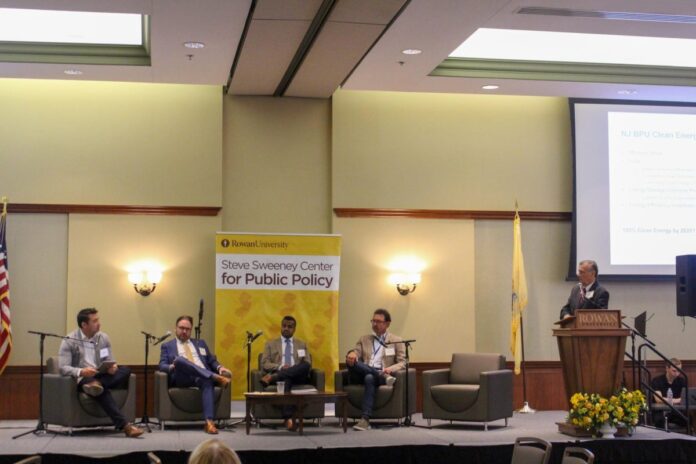

As New Jersey confronts rising electricity demand, ambitious clean-energy targets, expanding data infrastructure, and growing concerns about long-term grid reliability, one question is rapidly moving from the margins of policy discussions to the center of the state’s economic future: how will New Jersey generate enough dependable power to support the next generation of growth?
That question took center stage at Rowan University as policymakers, utility executives, environmental leaders, labor representatives, academics, and nuclear industry experts gathered for a major conference examining the future of nuclear energy in New Jersey. Hosted by the Rowan Energy Collaborative and the Steve Sweeney Center for Public Policy, the summit focused on one of the most consequential issues facing the state today: whether expanding nuclear generation capacity will become a necessary component of New Jersey’s long-term energy strategy.
The conference arrives at a critical moment. Across the country, states are grappling with a reality that would have seemed unlikely just a few years ago. After decades of relatively predictable electricity demand, the rapid growth of artificial intelligence, cloud computing, advanced manufacturing, electric vehicles, and large-scale data centers has dramatically altered projections for future energy consumption. At the same time, policymakers remain committed to reducing carbon emissions and transitioning toward cleaner forms of power generation. Those dual pressures have forced energy planners to confront a difficult challenge: how to produce more electricity while simultaneously reducing emissions.
For New Jersey, that challenge is particularly complex. The state is densely populated, highly developed, and heavily dependent on a reliable power grid that supports everything from pharmaceutical research and financial services to manufacturing operations and transportation systems. As demand continues to increase, many experts believe the conversation can no longer focus exclusively on renewable energy sources alone. Instead, they argue that nuclear energy must be part of a broader portfolio capable of providing dependable, around-the-clock electricity.
That perspective was reflected throughout the conference as speakers examined both the opportunities and obstacles associated with expanding nuclear power in New Jersey. The discussion centered not only on traditional large-scale nuclear facilities but also on emerging technologies such as Small Modular Reactors, often referred to as SMRs. These next-generation systems have become one of the most closely watched developments in the energy industry because they promise a different approach to nuclear generation. Unlike conventional reactors, SMRs are designed to be smaller, more flexible, and potentially faster to deploy while maintaining the reliability that has long made nuclear power attractive as a source of carbon-free electricity.
One of the most significant projects currently under discussion involves the former Oyster Creek site in Ocean County. Once home to one of the nation’s most recognizable nuclear facilities, the location has become a focal point in conversations about the future of advanced reactor technology. Holtec, which is pursuing plans involving Small Modular Reactors at the site, participated in the conference alongside policymakers and industry stakeholders interested in exploring what such a development could mean for New Jersey’s energy future. Supporters view Oyster Creek as a potential example of how existing energy infrastructure sites could be reimagined to meet modern demands while maintaining the state’s commitment to cleaner energy production.
Another major topic involved the possibility of expanding generation capacity at the Salem nuclear complex. Discussions surrounding a potential fourth reactor at Salem represent some of the most ambitious energy planning conversations currently taking place in New Jersey. While any such project would require years of planning, regulatory review, financial analysis, and public discussion, its inclusion in the conference highlights the growing recognition that existing nuclear assets may play an increasingly important role in meeting future electricity needs.
The conference also underscored the degree to which nuclear energy has moved beyond being simply an environmental or utility issue. Today, discussions about power generation are deeply connected to economic development, workforce planning, business attraction, and long-term competitiveness. Modern industries require enormous amounts of electricity. Artificial intelligence operations, data centers, semiconductor manufacturing, biotechnology research facilities, and advanced industrial operations all depend on access to stable, affordable power supplies. Without sufficient generation capacity, states risk losing investment opportunities to regions better positioned to meet those demands.
That economic dimension was evident throughout the event as leaders discussed the relationship between energy infrastructure and job creation. Expanding nuclear capacity would not only involve the construction and operation of generating facilities but also require substantial investments in workforce development, education, engineering, skilled trades, and technical training. Representatives from labor organizations, educational institutions, and economic development agencies explored how New Jersey could prepare the next generation of workers for careers connected to a changing energy landscape.
The presence of key state leaders further emphasized the importance of the discussion. New Jersey Board of Public Utilities President Christine Guhl-Sadovy, who serves as co-chair of Governor Mikie Sherrill’s Nuclear Policy Task Force, participated in the conference alongside Department of Environmental Protection Commissioner Ed Potosnak and Economic Development Authority CEO Evan Weiss. Their involvement reflects the growing recognition within state government that decisions regarding energy policy will have far-reaching consequences extending well beyond utility bills and power generation.
At the heart of the conversation is a broader debate about how New Jersey balances environmental objectives with economic realities. Nuclear energy remains one of the few large-scale sources of carbon-free electricity capable of operating continuously regardless of weather conditions. Advocates argue that achieving aggressive emissions reduction goals while supporting economic growth may prove impossible without maintaining and potentially expanding nuclear generation. Critics continue to raise questions regarding cost, regulation, waste management, and public acceptance. The conference provided a forum for examining those competing perspectives while focusing on practical solutions rather than ideological positions.
Another significant component of the summit involved the presentation of preliminary findings from a Rowan University research initiative examining pathways for expanding nuclear generation within New Jersey. Researchers from multiple academic disciplines, including engineering, economics, public policy, environmental science, and business, are working to evaluate the costs, benefits, environmental impacts, and implementation challenges associated with various expansion scenarios. Their work reflects a growing effort to ground future policy decisions in detailed analysis rather than political rhetoric.
The conference also highlighted Rowan University’s evolving role as a center for policy research and public dialogue. Long recognized as one of New Jersey’s fastest-growing institutions of higher education, Rowan has increasingly positioned itself as a place where complex statewide challenges can be examined through collaboration between academia, industry, government, and community stakeholders. Energy policy has become a particularly important area of focus as the state navigates the intersection of environmental goals, economic development, technological innovation, and infrastructure planning.
There is also a certain historical symmetry to the gathering. Nearly sixty years ago, the campus gained international attention when world leaders met in Glassboro to discuss some of the most pressing geopolitical challenges of the Cold War. Today, Rowan once again finds itself hosting discussions about a different kind of challenge—one that may ultimately prove equally important to the state’s future prosperity. The topic is no longer international diplomacy but rather how New Jersey will power its economy, support its residents, attract investment, and maintain reliability in an era of unprecedented energy demand.
What emerged from the conference was not a single answer but a growing consensus that the state’s energy future requires serious examination of every available option. As policymakers look toward the coming decades, nuclear energy is increasingly being discussed not as a legacy technology but as a potential cornerstone of future economic and environmental planning. Whether through Small Modular Reactors, expanded generation at existing facilities, or new approaches still under development, the conversation is clearly accelerating.
The significance of that shift cannot be overstated. Decisions made over the next several years will influence where businesses invest, how communities grow, what industries thrive, and how effectively New Jersey competes in a rapidly changing national economy. Reliable energy has always been essential to economic growth. In a future increasingly defined by technology, electrification, and data-driven industries, it may become more important than ever.
As the conference concluded, one reality remained unmistakably clear: New Jersey’s energy conversation has entered a new chapter. The questions being debated in Glassboro today are not simply about power plants or utility infrastructure. They are about the state’s long-term future, its economic competitiveness, its environmental commitments, and its ability to meet the demands of a rapidly changing world. For that reason alone, the discussions taking place at Rowan University may ultimately rank among the most important policy conversations unfolding anywhere in New Jersey this year.